
06072026 Bharath, Editorials:
- Student founders are beginning with classroom projects, hackathons, and local problems, then converting those ideas into early prototypes and real StartUps.
- College incubators and technology business incubators are giving students access to mentoring, labs, and early support before they graduate.
- The culture of “build first, pitch later” is growing fast, especially in engineering colleges and innovation hubs.
- Prototype culture is helping students learn how to test ideas quickly instead of waiting for a perfect product.
- Young founders from Andhra Pradesh, Telangana and other innovation-heavy regions are showing that StartUp ambition can begin on campus, not only in corporate life.
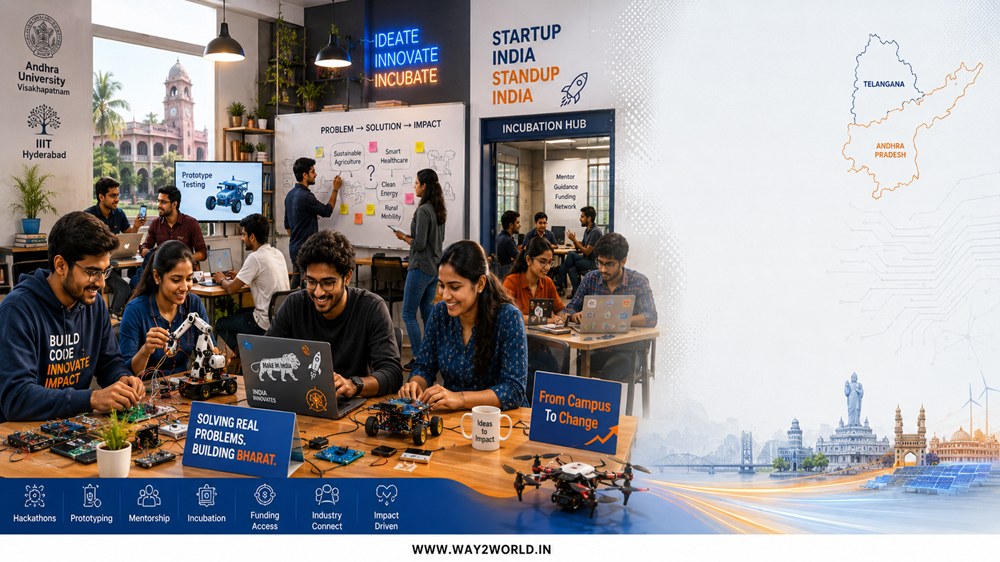
India’s youngest founders are no longer waiting for a degree to start building. Across engineering colleges, state universities, hackathons, maker spaces and incubators, students are turning classroom ideas into real products while they are still figuring out attendance, assignments and entrepreneurship at the same time.
What if your final-year project did not end in a viva, but became a company?
That is increasingly the reality in India, where student founders are using hackathons, maker spaces, and college incubators to build StartUps earlier than ever. The shift is changing how young people think about careers, innovation, and opportunity.
India’s StartUp ecosystem is seeing a major cultural shift: the founder journey is beginning much earlier, often before graduation. A decade ago, students usually treated innovation as an extracurricular activity.
Today, many see it as a serious path to building companies, solving local problems and creating jobs. This change is being powered by engineering colleges, innovation cells, incubators and peer communities that make StartUp thinking feel practical instead of abstract.
The biggest driver is access. Students now have more exposure to mentors, prototype labs, design tools, and StartUp programs than previous generations did.
That means a student with an idea for a low-cost device, a rural app, or a smart solution for local businesses no longer has to wait until after college to begin. They can test, build, fail, and improve while still on campus.
Early experimentation matters because StartUps rarely begin with perfection. They begin with confusion, coffee, and a rough first prototype.
Hackathons have become especially important. They compress creativity into a short timeline and push students to solve real problems under pressure.
For many student founders, a hackathon is the moment when a class project stops being a classroom exercise and starts looking like a business. College competitions, demo days, and maker clubs then help them refine the idea, talk to users, and get feedback.
This ecosystem is particularly visible in states with strong engineering education and youth-led innovation cultures.
Students from Andhra Pradesh and Telangana, for example, often begin with local problems they can personally see: transport, farming, affordability, education, or healthcare access. Because the problem is familiar, the solution feels urgent. And urgency is a very underrated StartUp fuel.
College incubators play a crucial role here. They give student founders something every StartUp needs early on: structure. A team may have the idea, but incubation helps with direction, validation, and discipline.
Difficult situations also teach young founders how to think beyond the product and ask harder questions:
- Who is the customer?
- Will they pay?
- Can this scale?
- Can it survive outside a classroom demo?
Those questions are less glamorous than a launch video, but far more useful.
Prototype culture is another reason this trend is rising. Students are learning that a working model beats a polished slide deck. A rough device, app, or service can reveal more than weeks of theory.
It shows what users actually want, what fails in the field, and what must be changed before launch. In that sense, campus innovation is training founders in real-world humility, which is a polite way of saying the market will correct your overconfidence very quickly.
For the wider StartUp ecosystem, this trend is important because it expands the founder pipeline. It brings in younger, more diverse, and often more hands-on innovators.
This also strengthens the link between education and entrepreneurship. Instead of preparing students only for jobs, colleges are increasingly preparing them to create opportunities.
That shift supports the broader #makeinindia story because many student-led StartUps are focused on local needs, not imported trends.
The opportunity is especially strong in deep-tech, hardware, agri-tech, mobility and social-impact ideas. These are areas where long learning cycles matter, and campus incubation gives students a head start.
By the time they graduate, they may already have validated a market, built a prototype and spoken to users. That is a serious advantage in a crowded StartUp environment.
In short, student founders are not waiting for permission anymore. They are using campus resources to build early, learn fast and enter the market with more confidence than ever before.
The result is a StartUp ecosystem that is younger, more experimental and far better connected to the realities of India’s local problems.
In A Nutshell:
- Student entrepreneurship is rising because college ecosystems now support early building.
- Hackathons are turning classroom ideas into practical StartUp opportunities.
- Incubators help students move from prototypes to structured ventures.
- Local problems often produce the strongest student-led StartUp ideas.
- Early exposure to mentoring and labs gives young founders a major advantage.
India’s next generation of founders is being shaped in classrooms, labs, and hackathons, not just in boardrooms. As colleges continue building stronger incubation support and prototype culture, more students will move from “idea stage” to “StartUp stage” before graduation.
That is good for innovation, good for entrepreneurship and very good for the future of Indian StartUps.
Way2World invites you to follow our pages on Facebook and LinkedIn. #Way2World provides insights and news regarding #Founders, #Co-Founders, #WomenEntrepreneurs, #WomenLeaders, #Mentors, #Innovation, #Incubators, #Accelerators, and #Listing. Our #Articles, #Reviews, and #Stories explore topics related to #Funding, #IndianStartUps, their #BusinessServices, as well as the impact of #Technology. Please note that this content, including images, is generated with the assistance of AI tools and is intended solely for informational purposes regarding current trends. It is not a recommendation. We advise conducting thorough analyses tailored to your specific needs and consulting with experts in the field. Content includes contributions from the Internet – RajKishan Ganta.
DISCLAIMER: The information presented in this news item is intended solely for informational purposes and should not be interpreted as professional advice, legal opinion, or endorsement by WAY2WORLD.
We cannot guarantee the accuracy, completeness, or timeliness of the information provided as most is generated using AI. Please Note content is Generated with AI which can make mistakes. WAY2WORLD and its affiliates disclaim any liability for errors, omissions, or damages resulting from reliance on this content.
Readers are strongly encouraged to verify information through multiple sources and to consult with qualified professionals before making decisions based on this material.
The views expressed in this news item reflect the opinions of the author(s) and do not necessarily represent those of WAY2WORLD or its affiliates.
WAY2WORLD does not endorse or promote any specific product, service, or organization mentioned herein unless explicitly stated. We urge readers to exercise their discretion and judgment when interpreting and applying the information.
Comments made in this space do not represent the views of WAY2WORLD. Individuals posting comments assume full responsibility for their content. In accordance with Central Government IT regulations, any obscene or offensive statements against individuals, religions, communities, or nations are punishable offenses and legal action may be pursued against violators.
View More To Know More: