
03072026 Bharath, Editorials:
- HealthTech in India is moving from “smart hospital tech” to “last-mile healthcare,” reaching villages and small towns where access has long been uneven.
- StartUps such as Dozee are showing how continuous remote monitoring can help doctors track patients without keeping every case inside a big-city hospital bed.
- Portable diagnostics and affordable digital tools are making it easier for primary health centres to catch problems earlier, before they become expensive emergencies.
- The strongest HealthTech ideas are now built for local reality: limited staff, patchy connectivity, and patients who need simple, low-cost solutions.
- The next wave of #makeinindia healthcare innovation is likely to come from products that save time, reduce travel, and bring specialist-level support closer to villages.
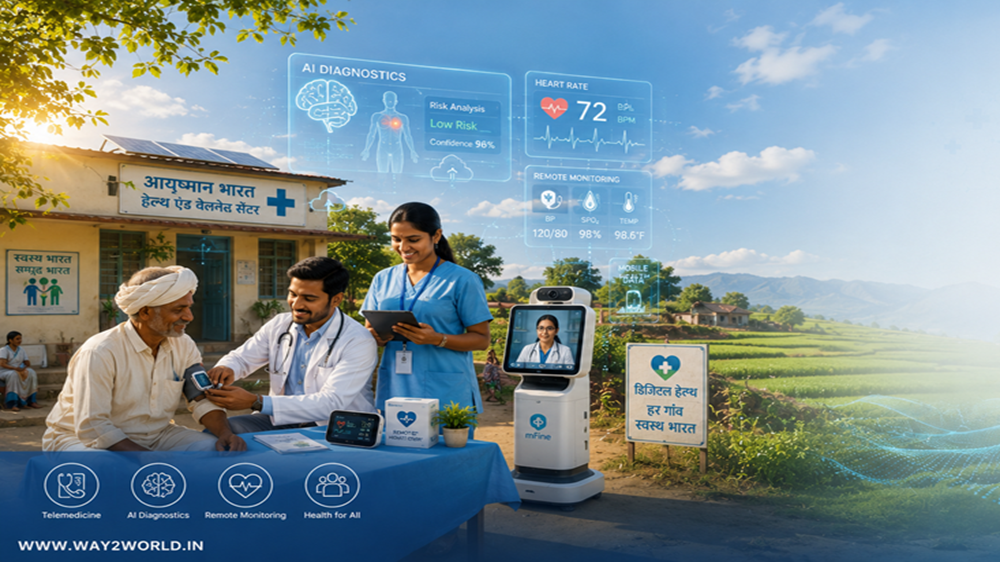
What does the future of healthcare look like when the nearest specialist is hundreds of kilometres away? In India, HealthTech StartUps are answering that question with remote monitoring, AI diagnostics, portable devices and preventive care tools designed for district hospitals and primary health centres, not just metro hospitals.
For years, India’s healthcare innovation story was centred on large hospitals, private chains and city-based doctors.
That picture is changing fast. Today, a new generation of HealthTech StartUps is building tools that reach district hospitals, primary health centres and rural communities, proving that technology can travel farther than medicine vans and faster than paperwork.
India’s HealthTech ecosystem is no longer just about expensive hospital software or premium telemedicine apps. It is increasingly focused on practical innovation: AI diagnostics, remote monitoring, portable medical devices, preventive healthcare and affordable testing that can work in a small clinic with limited staff.
That shifts matter because the real healthcare gap in India is often not the absence of doctors alone, but the absence of timely access. A village patient may not need a giant hospital dashboard; they may need a simple, reliable device that alerts a nurse before a condition worsens.
This is where StartUps like Dozee fit into the story. Dozee has become known for remote patient monitoring and contactless sensing, which can help healthcare workers observe patient vitals continuously without constant manual checks.
In a district hospital, that can mean better response times, less pressure on nurses, and earlier intervention. In plain language, it helps one nurse watch more patients without turning into a caffeine-fuelled superhero.
The broader relevance goes beyond one company. HealthTech StartUps are designing products for the realities of Indian healthcare: crowded wards, uneven internet, low budgets, and high patient loads.
That means innovation has to be rugged, affordable, and easy to use. It is also creating opportunities for engineers, clinicians, and founders who understand local conditions rather than importing a one-size-fits-all model. For the StartUp ecosystem, this is a major shift in ambition.
Instead of asking only how to build for urban consumers, founders are now asking how technology reaches villages, how it helps a community health worker, and how it reduces the cost of care without reducing quality. That is the real digital transformation story in healthcare, and it is one of the most important business ideas emerging from India today.
In A Nutshell:
- Rural healthcare needs simple technology, not just advanced technology.
- Remote monitoring can improve patient care even where doctors are scarce.
- Portable devices are making diagnostics more accessible outside metro cities.
- HealthTech founders are solving for infrastructure limits, not ignoring them.
- The biggest opportunity is in building products that fit Indian ground realities.
HealthTech StartUps are proving that innovation does not need to stay inside big-city hospitals to matter. By building for primary health centres, district hospitals, and rural patients, companies like Dozee are helping India move toward more accessible, preventive, and connected healthcare. The next big healthcare breakthrough may not look futuristic at first glance; it may simply look useful, affordable, and close to home.
Way2World invites you to follow our pages on Facebook and LinkedIn. #Way2World provides insights and news regarding #Founders, #Co-Founders, #WomenEntrepreneurs, #WomenLeaders, #Mentors, #Innovation, #Incubators, #Accelerators, and #Listing. Our #Articles, #Reviews, and #Stories explore topics related to #Funding, #IndianStartUps, their #BusinessServices, as well as the impact of #Technology. Please note that this content, including images, is generated with the assistance of AI tools and is intended solely for informational purposes regarding current trends. It is not a recommendation. We advise conducting thorough analyses tailored to your specific needs and consulting with experts in the field. Content includes contributions from the Internet – RajKishan Ganta.
DISCLAIMER: The information presented in this news item is intended solely for informational purposes and should not be interpreted as professional advice, legal opinion, or endorsement by WAY2WORLD.
We cannot guarantee the accuracy, completeness, or timeliness of the information provided as most is generated using AI. Please Note content is Generated with AI which can make mistakes. WAY2WORLD and its affiliates disclaim any liability for errors, omissions, or damages resulting from reliance on this content.
Readers are strongly encouraged to verify information through multiple sources and to consult with qualified professionals before making decisions based on this material.
The views expressed in this news item reflect the opinions of the author(s) and do not necessarily represent those of WAY2WORLD or its affiliates.
WAY2WORLD does not endorse or promote any specific product, service, or organization mentioned herein unless explicitly stated. We urge readers to exercise their discretion and judgment when interpreting and applying the information.
Comments made in this space do not represent the views of WAY2WORLD. Individuals posting comments assume full responsibility for their content. In accordance with Central Government IT regulations, any obscene or offensive statements against individuals, religions, communities, or nations are punishable offenses and legal action may be pursued against violators.
View More To Know More: