
11062026 Bengaluru, Indian Institute of Science:
|
One of the biggest challenges in cancer treatment is not creating powerful drugs, it is delivering them effectively. Traditional chemotherapy often travels throughout the body, affecting both cancerous and healthy cells.
This can lead to severe side effects and reduced treatment efficiency. Many solid tumours also develop dense tissue barriers that prevent medicines from reaching their core. Researchers worldwide have been searching for ways to overcome this challenge for decades.
What if cancer treatment could become as precise as delivering a package to the exact address instead of dropping it across an entire city?
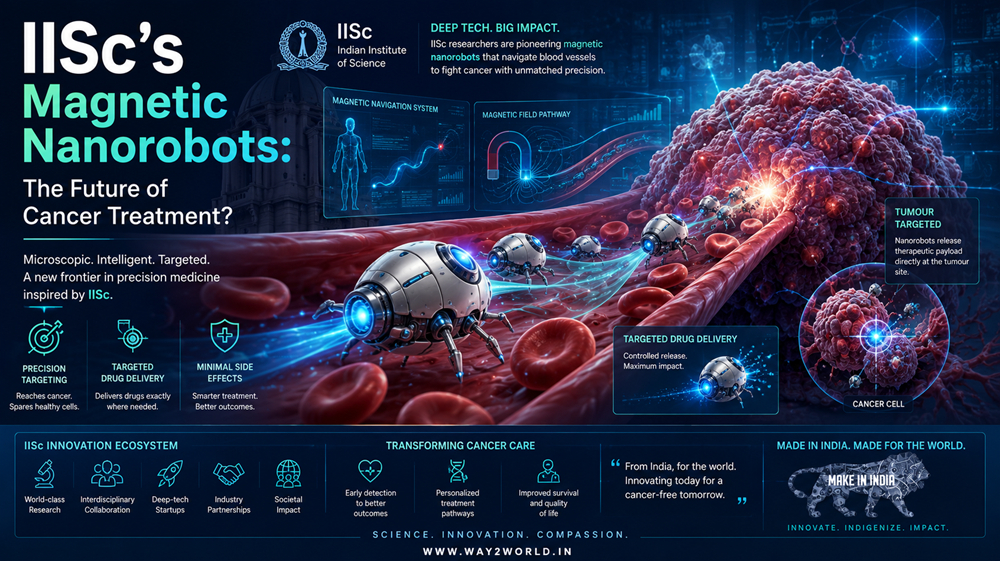
That is the vision driving the work of Professor Ambarish Ghosh and his team at the Indian Institute of Science (IISc), Bengaluru. Their magnetic nanorobots, tiny helical machines controlled by external magnetic fields, are being designed to navigate inside the human body, reach tumours directly and potentially deliver therapies exactly where they are needed.
While the technology is still under development and clinical translation remains a future goal, the research has already attracted global recognition for its potential to revolutionize targeted medicine.
A Problem Bigger Than Cancer Drugs:
Professor Ambarish Ghosh‘s team approached the problem differently. Instead of asking how to make stronger drugs, they asked how to deliver existing therapies more precisely. That question led to the development of magnetic nanorobots.
What Exactly Are Magnetic Nanorobots?
- Imagine a machine smaller than a human cell.
- Now imagine thousands of them moving through the body like miniature submarines.
The IISc nanorobots are tiny helical structures inspired by bacterial movement. Their corkscrew-like design allows them to move through fluids and biological environments when guided by external magnetic fields.
The robots contain magnetic materials that respond to controlled magnetic signals, enabling researchers to steer them with remarkable precision.
Unlike many futuristic concepts that exist only in animation videos, these nanorobots have already been demonstrated in laboratory environments and biological models.
The technology has shown the ability to navigate through tissue-like environments, enter cells, and interact with complex biological systems.
How the Technology Works:
- The concept is surprisingly elegant.
- Researchers can coat nanorobots with therapeutic agents or diagnostic materials. Once introduced into the body, external magnetic fields guide them toward specific locations.
- Think of it as GPS navigation for microscopic machines.
- Instead of flooding the entire body with medication, the goal is to deliver treatment directly to cancer cells while minimizing damage to healthy tissues.
This approach could significantly improve treatment efficiency while reducing side effects associated with conventional therapies.
The team has also demonstrated that these magnetic nanomotors can generate localized heat through magnetic hyperthermia, creating another possible pathway for targeted cancer therapy. Laboratory studies showed temperature increases sufficient to damage cancer cells under controlled conditions.
What This Matters for the Indian Innovation Ecosystem?
- The significance of this research extends far beyond healthcare.
- For the Indian StartUp ecosystem, the project represents something equally important: deep-tech innovation built on years of scientific research.
- Much of today’s StartUp conversation revolves around apps, marketplaces, and digital platforms.
While these sectors remain important, technologies like magnetic nanorobotics highlight India’s growing capability in advanced science, healthcare innovation, and translational research.
This is where #TechnologyTrends meets #makeinindia. It is also where #Leadership meets long-term vision. Building a food delivery app might take months. Building microscopic robots that navigate inside living tissue can take years of experimentation, interdisciplinary collaboration, and scientific persistence. That difference matters.
Lessons for StartUp Founders and Innovators:
1. Solve Fundamental Problems
- Great innovations target root causes rather than symptoms.
- The IISc team is not merely improving cancer treatment. They are attempting to solve one of medicine’s most difficult delivery challenges.
2. Deep-Tech Requires Patience
- Many founders seek rapid results.
- Scientific breakthroughs often require long development cycles. The nanorobotics journey demonstrates the importance of sustained commitment to a mission.
3. Interdisciplinary Collaboration Creates Breakthroughs
- This research combines physics, nanotechnology, biology, medicine, engineering, and materials science.
- Innovation increasingly happens at the intersection of disciplines.
4. Global Impact Can Start in India
- The work has received international attention, including recognition through the Tata Transformation Prize awarded by the New York Academy of Sciences in 2025.
From Cancer Therapy to Broader Applications :
- The potential applications extend beyond oncology.
- Research from the IISc group has explored nanorobotics in diagnostics, cellular sensing, targeted therapy, and even dentistry.
- Related technologies have already been translated into commercial applications through deep-tech ventures emerging from the research ecosystem.
This demonstrates how fundamental research can eventually create entirely new industries.
The story of Ambarish Ghosh and IISc’s magnetic nanorobots is not simply a story about cancer treatment. It is a story about ambitious thinking. It shows what becomes possible when scientists challenge assumptions and pursue solutions that initially seem impossible.
While clinical adoption will require further research and validation, the vision is powerful: a future where treatments are smarter, more targeted and less painful, with not much of side effects on the non affected parts of the body.
For founders, students, and innovators, the lesson is clear, sometimes the biggest opportunities lie in solving the hardest problems.
Way2World invites you to follow our pages on Facebook and LinkedIn. #Way2World provides insights and news regarding #Founders, #Co-Founders, #WomenEntrepreneurs, #WomenLeaders, #Mentors, #Innovation, #Incubators, #Accelerators, and #Listing. Our #Articles, #Reviews, and #Stories explore topics related to #Funding, #IndianStartUps, their #BusinessServices, as well as the impact of #Technology. Please note that this content, including images, is generated with the assistance of AI tools and is intended solely for informational purposes regarding current trends. It is not a recommendation. We advise conducting thorough analyses tailored to your specific needs and consulting with experts in the field. Content includes contributions from the Internet – RajKishan Ganta.
DISCLAIMER: The information presented in this news item is intended solely for informational purposes and should not be interpreted as professional advice, legal opinion, or endorsement by WAY2WORLD.
We cannot guarantee the accuracy, completeness, or timeliness of the information provided as most is generated using AI. Please Note content is Generated with AI which can make mistakes. WAY2WORLD and its affiliates disclaim any liability for errors, omissions, or damages resulting from reliance on this content.
Readers are strongly encouraged to verify information through multiple sources and to consult with qualified professionals before making decisions based on this material.
The views expressed in this news item reflect the opinions of the author(s) and do not necessarily represent those of WAY2WORLD or its affiliates.
WAY2WORLD does not endorse or promote any specific product, service, or organization mentioned herein unless explicitly stated. We urge readers to exercise their discretion and judgment when interpreting and applying the information.
Comments made in this space do not represent the views of WAY2WORLD. Individuals posting comments assume full responsibility for their content. In accordance with Central Government IT regulations, any obscene or offensive statements against individuals, religions, communities, or nations are punishable offenses and legal action may be pursued against violators.
View More To Know More:
- https://timesofindia.indiatimes.com/city/bengaluru/iisc-startup-develop-magnetic-nanobots-to-treat-tooth-sensitivity/articleshow/123288998.cms
- https://www.insightsonindia.com/2025/12/26/nanobots/
- https://www.iisc.ac.in/nanorobots-as-mobile-nanotweezers/
- https://www.cense.iisc.ac.in/ambarish/research-highlights/
- https://www.cense.iisc.ac.in/ambarish/nanorobotics/
- https://iisc.ac.in/magnetic-nanomotors-for-cancer-therapeutics/