
24072026 Bharath, Editorials:
…..Contd from: Embedded Finance: How StartUps Are Becoming Banks Without Licenses 2/2
This is a founder-focused Embedded Finance Playbook for the Indian StartUp ecosystem.
- Embedded finance lets Indian StartUps behave like banks without licences, by plugging into regulated rails and APIs instead of building full-stack institutions.
- MSMEs can now access credit, payments and savings inside tools they already use—turning apps and platforms into everyday financial gateways.
- RBI guidelines, India Stack and API-driven partnerships give founders a clear framework to innovate without ignoring compliance risks.
- Deep fintech plays—neo-banks, BNPL, SMB dashboards, payroll-linked savings—are becoming core infrastructure for India’s digital and small-business economy.
- The founders who win will be those who treat embedded finance as a trust business first, and a tech business second.
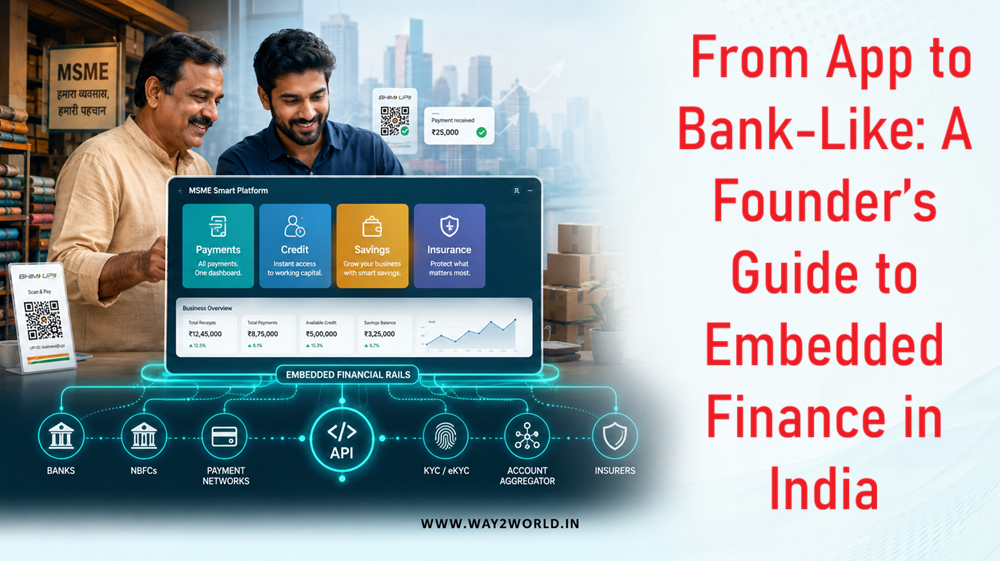
What if your StartUp could offer payments, credit or savings without chasing a banking licence? Embedded finance in India makes that possible. By partnering with regulated players and using APIs, early-stage founders can turn their products into financial access points for MSMEs and consumers and unlock new revenue streams along the way.
Early-stage Indian founders often underestimate embedded finance. At its core, it is simple: instead of building a bank, you build on a bank. Your product becomes the front door; regulated partners, India Stack and APIs handle the rails. This is a perfect fit for India, where digital payments are mature and MSMEs increasingly live inside apps and platforms.
The ecosystem spans several plays. BNPL and embedded credit solve checkout and cashflow pain by offering small-ticket loans where the transaction happens. Neo-banks and SMB-focused tools provide current-account like experiences, invoicing, collections and credit access without handling licences directly.
Payroll-linked savings and credit lines help employees build buffers or tap short-term finance seamlessly from salary flows. API-first providers sit beneath all this, giving StartUps plug-and-play access to payments, KYC, lending and data.
Regulation is not a barrier; it is a map. RBI guidelines around digital lending and aggregators signal what good behaviour looks like. India Stack and UPI show how responsible innovation can scale.
For founders, the challenge is not “Can I be a bank?” but “Can I become the most trusted interface my customer uses?” Embedded finance is the toolkit for that ambition.
In a Nutshell:
- Embedded finance lets Indian StartUps act as financial access points without chasing full licences, by plugging into regulated rails and APIs.
- The smartest founders pick one sharp use case—such as MSME cashflow or payroll-linked savings—instead of trying to “Fintech everything.”
- Trust and compliance are not optional; they are core product features that determine whether users stay or leave.
- Strong partnerships with banks, NBFCs and API vendors are as important as UI, because outages and disputes can damage your brand.
- Measuring both ROI and risk from day one turns embedded finance from a feature into a repeatable business model.
Embedded finance is quietly turning Indian StartUps into everyday financial touchpoints for MSMEs and consumers. For early-stage founders, the opportunity is to design products where finance feels native, safe and useful—while letting licensed partners handle the heavy regulatory lifting. Do that well, and new revenue follows naturally.
EMBEDDED FINANCE PLAYBOOK (for early-stage Indian founders)
1. Understand the ecosystem before you touch money
- Map the players: banks, NBFCs, payment aggregators, API providers, KYC/identity services.
- Decide your lane: payments, credit, savings, insurance, or a focused SMB product.
- Accept a simple rule: you will be an interface and orchestrator, not a bank.
2. Pick one sharp use case, not “Fintech everything”
- Choose the highest-impact, lowest-friction problem for your user (e.g., faster payouts for merchants, credit at checkout, payroll-linked savings).
- Start with a single flow you can explain in one sentence.
- Design the UX so finance feels like an invisible helper, not a separate chore.
3. Design for trust first, then growth
- Be extremely clear about who is providing the financial service (you), who is licensed (your partner), and what the user is agreeing to.
- Make pricing, limits and repayment terms transparent.
- Build in basic guardrails: KYC, fraud checks, permissioned data use and human support.
4. Choose partners like co-founders, not vendors
- Evaluate potential banks, NBFCs and API platforms on reliability, documentation quality, support, and alignment with your segment (MSMEs, consumers, gig workers).
- Ask tough questions: What happens if their system is down? Who owns the customer relationship? How are disputes resolved?
- Think long-term, switching rails mid-journey is painful.
5. Build a simple compliance spine early
- Assume regulators will care more about your behaviour as you grow.
- Keep clean records: consent, transaction logs, communication, dispute resolution.
- Create a basic checklist: KYC, data protection, grievance redressal, and clear terms of service.
6. Instrument your product for ROI and risk
- Track both upside (conversion, usage, repeat rate, increased GMV) and downside (defaults, disputes, failed payments).
- Use those numbers to adjust limits, pricing and eligibility rules.
- Remember: embedded finance that cannot prove value will not survive procurement.
7. Treat MSMEs as partners, not just borrowers
- Help them understand cashflow, collections, credit behaviour and savings, not just offer one-click loans.
- Integrate financial tools into their daily workflows—billing, inventory, payouts, payroll.
- Encourage healthy usage; your best “marketing” is a merchant who sleeps better because your product works.
8. Pitch embedded finance as infrastructure, not hype
- When talking to investors or strategic partners, frame your product as a rails + interface combination that improves monetization, retention and data.
- Show how embedded finance deepens your moat: integrated in workflows, hard to replace, and more useful with each user.
- Make clear that your ambition is responsible growth, not “growth at any cost.”
Way2World invites you to follow our pages on Facebook and LinkedIn. #Way2World provides insights and news regarding #Founders, #Co-Founders, #WomenEntrepreneurs, #WomenLeaders, #Mentors, #Innovation, #Incubators, #Accelerators, and #Listing. Our #Articles, #Reviews, and #Stories explore topics related to #Funding, #IndianStartUps, their #BusinessServices, as well as the impact of #Technology. Please note that this content, including images, is generated with the assistance of AI tools and is intended solely for informational purposes regarding current trends. It is not a recommendation. We advise conducting thorough analyses tailored to your specific needs and consulting with experts in the field. Content includes contributions from the Internet – RajKishan Ganta.
DISCLAIMER: The information presented in this news item is intended solely for informational purposes and should not be interpreted as professional advice, legal opinion, or endorsement by WAY2WORLD.
We cannot guarantee the accuracy, completeness, or timeliness of the information provided as most is generated using AI. Please Note content is Generated with AI which can make mistakes. WAY2WORLD and its affiliates disclaim any liability for errors, omissions, or damages resulting from reliance on this content.
Readers are strongly encouraged to verify information through multiple sources and to consult with qualified professionals before making decisions based on this material.
The views expressed in this news item reflect the opinions of the author(s) and do not necessarily represent those of WAY2WORLD or its affiliates.
WAY2WORLD does not endorse or promote any specific product, service, or organization mentioned herein unless explicitly stated. We urge readers to exercise their discretion and judgment when interpreting and applying the information.
Comments made in this space do not represent the views of WAY2WORLD. Individuals posting comments assume full responsibility for their content. In accordance with Central Government IT regulations, any obscene or offensive statements against individuals, religions, communities, or nations are punishable offenses and legal action may be pursued against violators.
View More To Know More:
- https://scoopearth.in/embedded-finance-razorpay-stripe-india-paytm-where-its-going/
- https://www.linkedin.com/posts/abhijeetdavane_embeddedfinance-digitallending-rbi-activity-7382605193529638912-E-_b
- https://competitiveness.in/niti-aayog-releases-report-on-enhancing-competitiveness-of-msmes-in-india/
- https://www.policycircle.org/policy/india-msmes-funding-gap/
- https://www.upforge.org/blog/fintech-startups-india-2026
- https://www.stashfin.com/blogs/embedded-finance-upi-loans
- https://www.pwc.in/assets/pdfs/indian-payments-handbook-2025-2030.pdf