
29012026 Bharath, Editorials:
- If you had to describe your StartUp’s core problem in one WhatsApp message, what would you write—and would a stranger immediately understand it?
- How can Indian founders use local insights (language, culture, constraints) to define sharper problem statements than global competitors?
- Does your mission statement excite a 20-year old intern and a seasoned investor equally, or is it written only for pitch decks?
- How should brand stories evolve as a StartUp scales from idea stage to IPO without losing its original emotional hook?
- In a market with lakhs of recognized StartUps, what one line makes your vision meaningfully different—not just bigger or faster?
In a country with over 2 lakh DPIIT-recognized StartUps, the real scarcity isn’t ideas—it’s structured thinking. If you are a “wannapreneur” staring at a blank doc, this guide walks you from problem to brand story using practical #BusinessTips and Indian StartupStories you can relate to.
India now has more than 2.05 lakh DPIIT-recognized StartUps, up from just a few hundred in 2016, creating lakhs of direct jobs and pulling founders from metros and tier 2/3 cities alike. That growth means investors, incubators and accelerators are seeing thousands of decks, but only a fraction show a crisp problem statement, solution thesis, mission and brand narrative.
As StartUp India schemes, fund-of-funds programmes and state policies expand support, the bar for clarity keeps rising. For #EntrepreneursinIndia, learning to clearly define the “why”, “what” and “how” behind an idea is now as important as traction metrics when seeking #earlystagestartupfundingIndia2026 and getting noticed in a crowded funnel.
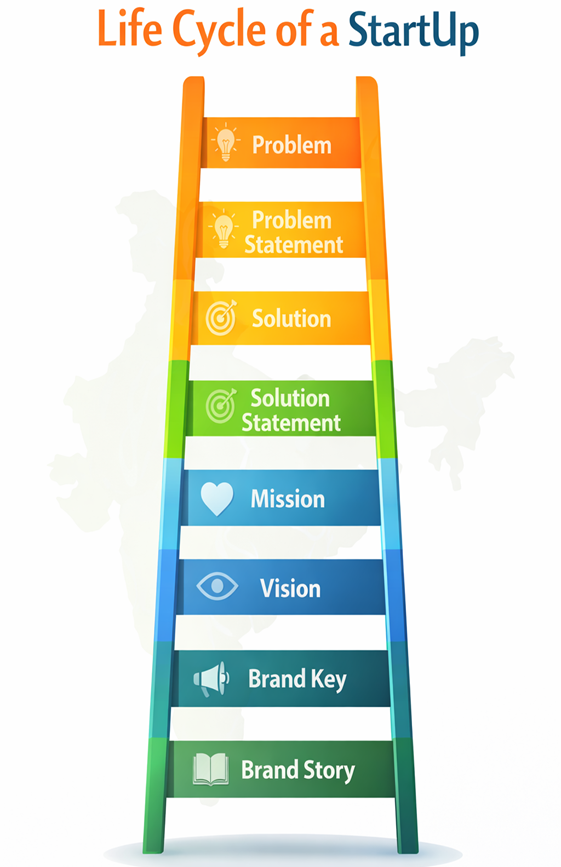
Here’s a detailed, practical breakdown of “From Wannapreneur To Founder: A Simple 8-Step StartUp Story Blueprint” tailored to the Indian StartUp ecosystem.
1. Step 1 – Identify a real problem (not just a cool idea)
Before you are a founder, you are a pattern spotter. Wannapreneurs often start with “I want to build an app”; real founders start with “someone is in pain here”.
Ways to identify a problem
- Observe daily frictions: traffic, payments, deliveries, healthcare access, education gaps, SME workflows.
- Talk to people: kirana owners, delivery partners, small manufacturers, parents, students.
- Look for repeated complaints where people are already hacking together solutions (Excel, WhatsApp, jugaad tools).
- Example:
- Dunzo started essentially as a WhatsApp concierge solving “I don’t have time to run 10 small errands in a city like Bengaluru.”
- UPI and fintech StartUps addressed the very visible pain of cash handling and unreliable online payments for small merchants.
Litmus test: If you removed the solution from your pitch, can you clearly say “X people face Y pain in Z situations”? If you cannot, you are still in wannapreneur territory.
2. Step 2 – Write a sharp problem statement
A problem statement forces you to move from “I feel this is an issue” to “here is the concrete, testable pain”.
Simple template:
- “TargetuserTarget userTargetuser struggles to doXdo XdoX because reasonreasonreason, leading to negativeoutcomenegative outcomenegativeoutcome.”
Examples:
- “Working parents in tier-1 Indian cities struggle to manage daily errands because of long commutes and unpredictable work hours, leading to stress and wasted time.” (Dunzo-like)
- “Small retailers in India struggle to accept and reconcile digital payments because existing tools are complex or fragmented, leading to revenue leakage and accounting errors.” (fintech / payments)
Do:
- Use plain language, not buzzwords.
- Include who, what, why and impact.
Don’t:
- Hide behind “lack of efficiency” or “poor experience” without describing the real-world pain (money, time, risk, emotion).?
3. Step 3 – Define a focused solution
Once the problem is pinned down, the solution is one clear way you will change that before you go big.
Checklist:
- Does it directly attack the cause, not just the symptom?
- Can you prototype it quickly (even via WhatsApp, Google Sheets, or no-code tools)?
- Can your user understand it in one sentence?
Example solution directions:
- For overwhelmed working parents: “an on?demand concierge that handles pickups, drops, and small tasks across the city.”
- For small retailers: “a simple Android app that accepts UPI and card payments and automatically reconciles daily totals.”
Frugal Indian founder mindset: build the smallest version that proves people care—often via existing channels before writing heavy code.?
4. Step 4 – Write a solution statement
Template:
- “Our solution is product/serviceproduct/serviceproduct/service that helps targetusertarget usertargetuser achievedesiredoutcomeachieve desired outcomeachievedesiredoutcome by keymechanismkey mechanismkeymechanism.”
Examples:
- “Our solution is a WhatsApp-based concierge that helps busy urban professionals get errands done by connecting them with verified local runners within minutes.” (Dunzo-style MVP)
- “Our solution is a mobile app that helps small shops accept digital payments and auto?reconcile sales by integrating UPI, cards and basic accounting in one simple interface.”
Good solution statements:
- Speak plainly.
- Focus on one primary outcome (save time, earn more, reduce risk).
- Avoid cramming in every feature; that’s for the roadmap, not the sentence.
5. Step 5 – Write a mission statement (your “why now”)
Mission is about why you exist today and what you will do consistently.
Simple pattern:
- “To actionverbaction verbactionverb whowhowho outcomeoutcomeoutcome.”
Examples (style, not verbatim):
- Swiggy’s mission emphasises “providing unparalleled convenience” in food and local services, signalling focus on everyday life improvements.
- You might say: “To make everyday errands effortless for urban Indians through reliable, tech-enabled local services.”
Tips:
- Use active verbs: empower, simplify, enable, connect.
- Keep it 1–2 lines; if it needs a paragraph, you are writing a pitch, not a mission.
- Make sure a new intern can remember it after hearing it once.
6. Step 6 – Write a vision statement (your “future picture”)
Vision is the long-term destination—what the world looks like if you win.
Template:
- “A world where changedrealitychanged realitychangedreality.” or “To become aspirationalpositionaspirational positionaspirationalposition in spacespacespace.”
Examples (style, not exact):
- Swiggy’s vision is often framed as becoming “India’s most loved convenience platform,” which extends beyond food delivery.
- For our errands StartUp: “To be India’s most trusted everyday help platform, connecting people with anything they need in under 30 minutes.”
Good vision statements:
- Are slightly ambitious, maybe even uncomfortable, but not vague.
- Give investors and team members a clear direction for 5–10 years.
7. Step 7 – Write a brand key statement (your positioning in one line)
Brand key is the positioning anchor—how you want to be tagged in the user’s mind.
Formula:
- “We are the shortdescriptionshort descriptionshortdescription for targettargettarget who want benefitbenefitbenefit.”
Examples:
- “We are the ‘Swiggy for errands’ for busy Indian professionals who want time back without sacrificing reliability.”
- For a vernacular edtech StartUp: “We are the ‘Duolingo of government exams’ for tier?2/3 students who want to learn in their own language.”
The brand key should:
- Be concrete enough to guide design, tone, partnerships.
- Help people place you next to something they already understand (“X for Y” can be useful in early days).
8. Step 8 – Write a brand story (emotion + proof)
This is where your human narrative sits: why you, why this problem, why now.
Basic arc:
- Origin: the moment you noticed the problem (a painful incident, a conversation, your own struggle).
- Conflict: what existing solutions got wrong (too expensive, too complex, too urban, not India-friendly).
- Decision: the moment you chose to build.
- Journey: early experiments, lucky breaks, failures.
- Destination: the vision you are inviting users, employees, and investors into.
Example sketch (for our errands StartUp):
- “In 2018, after missing yet another family function because of errands and traffic, I realised that urban convenience in India still depended on personal sacrifice. Swiggy could bring food, but not my dry cleaning or a last-minute gift. So I started manually coordinating errands for friends via WhatsApp groups. When those friends became 100 paying users, we turned the system into a simple app. Today, our mission is to give Indians back one hour a day, starting with the chores they hate but cannot avoid.”
Indian StartupStories—from Dunzo’s WhatsApp MVP to D2C brands run by first-time founders—often follow a similar pattern: personally felt pain – small hack – relentless iteration – clearer mission.
Putting it all together: a quick checklist
When you move from wannapreneur to founder, you should be able to answer, in writing:
- Problem statement – Who hurts? Why? What’s the cost?
- Solution statement – What exactly are you building to fix it?
- Mission – Why do you show up every day?
- Vision – What future are you marching toward?
- Brand key – How should people position you in their mind?
- Brand story – What human journey are they joining?
If you can say each of these in one or two sentences, you are no longer just someone “thinking about an idea”—you have a structured StartUp story that investors, incubators and future teammates can understand and remember.
Use this 8-step blueprint as a working document: revisit it every six months as your product, market and you evolve. The strongest Indian founders keep refining their narrative as ruthlessly as they refine their code or unit economics.
Look at any strong Indian StartUp brand—Swiggy promising “unparalleled convenience” in local services, or AI and SaaS ventures simplifying complex workflows—and you will find a tight problem–solution–mission chain behind the scenes. Successful founders rarely start with “we’ll build an app”; they start by naming a painful customer problem, then crafting a focused solution statement and a mission that can survive pivots.
Case studies show that the StartUps which endure funding cycles and valuation swings tend to have a clear vision of the future they want to create and a brand story that customers and employees can repeat without reading a pitch deck.
For wannapreneurs, the life cycle begins long before incorporation—it starts the moment you can describe a real human problem in one sentence. Nail your problem, solution, mission, vision and brand story early, and every future pitch, product roadmap and hiring decision becomes easier to align.
Indicative sources you can link for authenticity: DPIIT and StartUp India data on number of StartUps and ecosystem growth, IBEF/StartUp India reports on the role of StartUps in India’s economy and explainers on mission/vision statements and brand storytelling using Swiggy and other Indian brands as examples.
Way2World invites you to follow our pages on Facebook and LinkedIn. #Way2World provides insights and news regarding #Founders, #Co-Founders, #WomenEntrepreneurs, #WomenLeaders, #Mentors, #Innovation, #Incubators, #Accelerators, and #Listing. Our #Articles, #Reviews, and #Stories explore topics related to #Funding, #IndianStartUps, their #BusinessServices, as well as the impact of #Technology. Please note that this content, including images, is generated with the assistance of AI tools and is intended solely for informational purposes regarding current trends. It is not a recommendation. We advise conducting thorough analyses tailored to your specific needs and consulting with experts in the field. Content includes contributions from the Internet – RajKishan Ganta.
DISCLAIMER: The information presented in this news item is intended solely for informational purposes and should not be interpreted as professional advice, legal opinion, or endorsement by WAY2WORLD.
We cannot guarantee the accuracy, completeness, or timeliness of the information provided as most is generated using AI. Please Note content is Generated with AI which can make mistakes. WAY2WORLD and its affiliates disclaim any liability for errors, omissions, or damages resulting from reliance on this content.
Readers are strongly encouraged to verify information through multiple sources and to consult with qualified professionals before making decisions based on this material.
The views expressed in this news item reflect the opinions of the author(s) and do not necessarily represent those of WAY2WORLD or its affiliates.
WAY2WORLD does not endorse or promote any specific product, service, or organization mentioned herein unless explicitly stated. We urge readers to exercise their discretion and judgment when interpreting and applying the information.
Comments made in this space do not represent the views of WAY2WORLD. Individuals posting comments assume full responsibility for their content. In accordance with Central Government IT regulations, any obscene or offensive statements against individuals, religions, communities, or nations are punishable offenses and legal action may be pursued against violators.
Source:
- https://www.pib.gov.in/PressReleaseIframePage.aspx?PRID=2043805
- https://timesofindia.indiatimes.com/business/india-business/dpiit-recognised-startups-increased-to-more-than-1-2-lakh-by-march-2024-economic-survey/articleshow/111030088.cms
- https://www.tice.news/tice-trending/indias-start-up-moment-how-205-lakh-dpiit-recognised-ventures-are-redefining-the-countrys-growth-story
- https://www.ibef.org/blogs/the-role-of-startups-in-india-s-economic-growth
- https://www.startupindia.gov.in/content/sih/en/Prabhaav.html
- https://www.8base.com/blog/problem-statement-templates-and-examples
- https://yourstory.com/2016/06/10-real-problems-india-startups-can-aim-solve
- https://canvasbusinessmodel.com/blogs/mission/swiggy-mission
- https://razorpay.com/learn/vision-and-mission-statements-the-difference/
- https://eoicommunity.com/blog/wannapreneur-to-entrepreneur/
- https://blog.hubspot.com/sales/stages-of-entrepreneurship
- https://www.benetrends.com/blog/from-wantrepreneur-to-entrepreneur-the-essential-to-do-list/
- https://www.linkedin.com/pulse/five-stages-entrepreneurial-growth-which-stage-you-glenn-mattson-obcsc
- https://www.chrysalinks.co.za/blog/our-blog-1/the-5-stages-of-entrepreneurship-2
- https://blog.hubspot.com/sales/stages-of-entrepreneurship
- https://www.salaah.co.in/blog/from-idea-to-impact-a-3-phase-framework-for-indian-startups
- https://www.registerkaro.in/post/6-indian-entrepreneur-who-started-with-nothing
- https://yourstory.com/2023/05/rags-to-riches-inspiring-tales-of-indian-entrepreneurs
- https://www.8base.com/blog/problem-statement-templates-and-examples
- https://yourstory.com/2016/06/10-real-problems-india-startups-can-aim-solve
- https://razorpay.com/learn/vision-and-mission-statements-the-difference/
- https://canvasbusinessmodel.com/blogs/mission/swiggy-mission