
01092026 Bharat, Editorials:
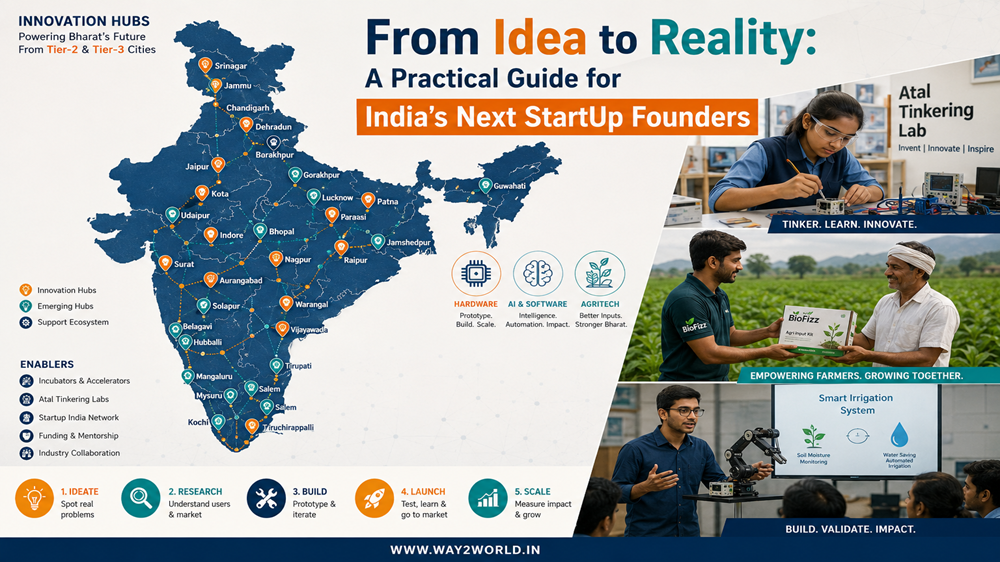
This is just an image of imagination made by AI, not any promo
-
India had more than 2 lakh DPIIT-recognised StartUps by December 2025, with over 10,000 Atal Tinkering Labs across 733 districts.
-
Regional ecosystems such as Kerala are producing deep-tech ventures like NeuroTech Labs and Netrasemi.
-
Applied-AI StartUps such as Othor AI are building for business intelligence, not just chatbots.
-
Agritech ventures like BioFizz Agritech are testing quick-commerce models for farm-input delivery.
-
The strongest StartUp journalism treats early ventures as signals, not guaranteed unicorns.
What separates a promising idea from a StartUp that actually works? India now has more than 2 lakh DPIIT-recognised StartUps and over 10,000 Atal Tinkering Labs across 733 districts. This guide turns five earlier stories into a practical playbook for founders who want to build, not just pitch.
India’s StartUp ecosystem is no longer concentrated in a handful of metros. With more than 2 lakh DPIIT-recognised StartUps and over 10,000 Atal Tinkering Labs across 733 districts, innovation is spreading into Tier-2 and Tier-3 cities. Regional founders are building deep-tech hardware, applied-AI software and agritech solutions that solve real problems.
NeuroTech Labs and Netrasemi show why sensors, chips and edge computing matter. Othor AI demonstrates how AI can support business intelligence beyond chatbots. BioFizz Agritech highlights the importance of last-mile delivery in rural markets. These ventures should be covered as signals, not proven unicorns.
The lesson for founders is clear: start with a specific problem, build a prototype, test it cheaply and gather evidence before scaling. Ask who has the problem, how often it occurs, what the current workaround is and which partners are essential.
Consider safety, privacy and regulatory risks early. This approach reduces risk and increases credibility. Investors, incubators and customers respond to evidence, not hype. The next wave of Indian StartUps will come from founders who combine regional insight with practical execution. That is the real story behind the numbers.
Lesson 1: The regional innovation map
India’s StartUp story is becoming more distributed. With more than 2 lakh DPIIT-recognised StartUps and over 10,000 Atal Tinkering Labs across 733 districts, innovation is no longer limited to Bengaluru, Hyderabad or Delhi-NCR.
Kerala, for example, is producing deep-tech ventures such as NeuroTech Labs and Netrasemi. These companies are building in-ear EEG technology and AI chips, respectively. Their stories show that regional ecosystems can support foundational technology when they combine education, incubation and talent.
For founders outside major metros, the lesson is not to wait for permission. Build where you are, use local institutions, tap regional talent and solve problems that matter to your community. The next big Indian StartUp may come from a city you have never heard of.
Lesson 2: Hardware is back
Software dominated the last decade of Indian StartUps. The next decade may belong to hardware. NeuroTech Labs and Netrasemi illustrate why sensors, chips and edge computing matter.
NeuroTech Labs is exploring in-ear EEG technology that could bring brain-signal monitoring into everyday earphones. Netrasemi is building AI chips for smart cameras, robotics and industrial automation. Both ventures require patience, prototyping and long development cycles.
For hardware founders, the lesson is to start with a narrow technical problem. Can you make a sensor smaller, more reliable or more affordable? Can you integrate multiple functions into one chip? Can you reduce power consumption without losing performance?
Hardware StartUps must also plan for manufacturing, testing, certification and customer integration. A successful prototype is not the same as a commercial product. But the opportunity is significant: every intelligent device needs computing hardware.
Lesson 3: AI beyond chatbots
Artificial intelligence is often associated with chatbots and content generation. Othor AI shows a different path: AI-native business intelligence for decision-making.
The company is building a platform that connects to business data, identifies important signals, detects anomalies and produces plain-language reports. Its goal is to make insights faster, easier and more secure than conventional dashboard-led tools.
For AI founders, the lesson is to focus on practical use cases. Can your AI tool solve a costly, frequent problem? Can it integrate with existing software? Can it reduce time or improve decisions?
Applied AI can support regional language, healthcare, agriculture and public-service use cases. The opportunity is not to build another chatbot, but to make AI useful for real organisations.
Lesson 4: Agritech that touches the ground
Agriculture has no shortage of apps. The harder challenge is reliable execution in villages. BioFizz Agritech is attempting to bring quick-commerce speed to farm-input delivery, starting from Nashik, Maharashtra.
The company says it can deliver inputs in approximately 20 minutes in its operating districts. It uses effervescent tablet-based agri-inputs, local “Bike Entrepreneurs” and a Smart App to reach farmers.
For agritech founders, the lesson is to focus on last-mile delivery, farmer trust and rural distribution. Can your product work across roads, markets, weather, rural purchasing habits and trust networks? Can you achieve repeat usage and sustainable unit economics?
The next agritech opportunity may not be another app, but a reliable delivery system that farmers can trust.
Lesson 5: What idea-stage founders must validate
Every StartUp begins with an idea. The question is whether the idea can survive contact with reality. Here is a practical checklist for idea-stage founders:
-
Who has the problem? Identify the specific customer segment.
-
How often does it occur? Measure frequency and urgency.
-
What is the current workaround? Understand existing solutions.
-
Can a prototype be tested cheaply? Build a minimum viable product.
-
What evidence would prove demand? Define success metrics.
-
Which partners are essential? Identify suppliers, distributors and advisors.
-
What safety, privacy or regulatory risks exist? Address compliance early.
This checklist reduces risk and increases credibility. Investors, incubators and customers respond to evidence, not hype.
In a Nutshell:
-
India had more than 2 lakh DPIIT-recognised StartUps by December 2025.
-
Over 10,000 Atal Tinkering Labs exist across 733 districts.
-
Regional ecosystems are producing deep-tech, AI and agritech ventures.
-
Hardware, applied AI and last-mile delivery are key opportunities.
-
Idea-stage founders must validate problems, prototypes and evidence.
India’s StartUp ecosystem is larger and more distributed than ever. With more than 2 lakh DPIIT-recognised StartUps and over 10,000 Atal Tinkering Labs across 733 districts, the opportunity is significant. The next wave will come from founders who combine regional insight with practical execution.
For #Way2WorldStories, the lesson is clear: build for real problems, test cheaply and gather evidence before scaling. That is how grassroots StartUp journalism earns trust: fewer grand predictions, more thoughtful questions—and absolutely no “revolutionary” label before the prototype has survived contact with reality. #TechnologyTrends and #DigitalTransformation become meaningful only when they improve the lives of real users.
Editorial disclaimer: This guide is based on earlier articles about NeuroTech Labs, Netrasemi, Othor AI and BioFizz Agritech. Those ventures should be covered as signals, not proven unicorns. Founders should independently validate problems, prototypes and evidence before scaling.
Way2World invites you to follow our pages on Facebook and LinkedIn. #Way2World provides insights and news regarding #Founders, #Co-Founders, #WomenEntrepreneurs, #WomenLeaders, #Mentors, #Innovation, #Incubators, #Accelerators, and #Listing. Our #Articles, #Reviews, and #Stories explore topics related to #Funding, #IndianStartUps, their #BusinessServices, as well as the impact of #Technology. Please note that this content, including images, is generated with the assistance of AI tools and is intended solely for informational purposes regarding current trends. It is not a recommendation. We advise conducting thorough analyses tailored to your specific needs and consulting with experts in the field. Content includes contributions from the Internet – RajKishan Ganta.
DISCLAIMER: The information presented in this news item is intended solely for informational purposes and should not be interpreted as professional advice, legal opinion, or endorsement by WAY2WORLD.
We cannot guarantee the accuracy, completeness, or timeliness of the information provided as most is generated using AI. Please Note content is Generated with AI which can make mistakes. WAY2WORLD and its affiliates disclaim any liability for errors, omissions, or damages resulting from reliance on this content.
Readers are strongly encouraged to verify information through multiple sources and to consult with qualified professionals before making decisions based on this material.
The views expressed in this news item reflect the opinions of the author(s) and do not necessarily represent those of WAY2WORLD or its affiliates.
WAY2WORLD does not endorse or promote any specific product, service, or organization mentioned herein unless explicitly stated. We urge readers to exercise their discretion and judgment when interpreting and applying the information.
Comments made in this space do not represent the views of WAY2WORLD. Individuals posting comments assume full responsibility for their content. In accordance with Central Government IT regulations, any obscene or offensive statements against individuals, religions, communities, or nations are punishable offenses and legal action may be pursued against violators.
Users are responsible for ensuring AI-generated content complies with copyright laws and community guidelines. AI tools should be used responsibly and ethically, with appropriate disclosures where required.
View More To Know More: