
25092026 Tamil N?du, Editorials:
-
GalaxEye secured a US patent in September 2026 for technology that synchronises optical and radar sensors on satellites.
-
The company launched Mission Drishti on 3 May 2026, described as the world’s first OptoSAR imaging satellite.
-
GalaxEye plans to deploy a 30-satellite constellation over the next five years, targeting 20 satellites manufactured per year by 2030.
-
The startup has raised around $21 million in funding and acquired Bengaluru-based StarOps in August 2026.
-
Mission Drishti experienced an operational setback in July 2026, losing contact following a geomagnetic solar storm.
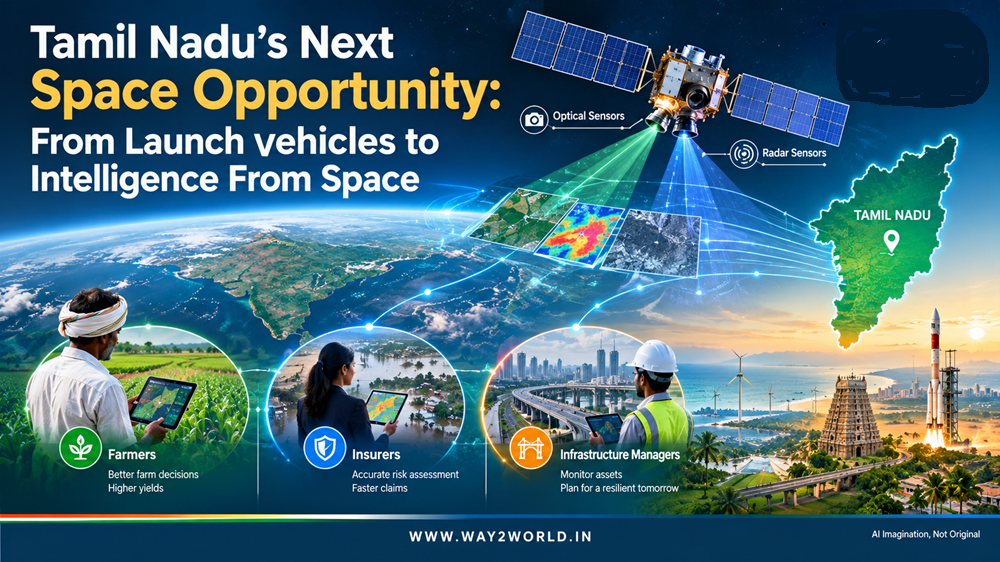
Can a Chennai-based StartUp help Tamil Nadu move from building rockets to selling intelligence from space? GalaxEye secured a US patent in September 2026 for synchronising optical and radar sensors, after launching Mission Drishti in May 2026. This article offers a practical framework for founders to turn space-tech into earth intelligence.
GalaxEye secured a US patent in September 2026 for technology that synchronises optical and radar sensors on satellites. The company launched Mission Drishti on 3 May 2026, described as the world’s first OptoSAR imaging satellite. GalaxEye plans to deploy a 30-satellite constellation over the next five years, targeting 20 satellites manufactured per year by 2030.
The opportunity is not just putting satellites into orbit. It is selling weather-independent earth observation for agriculture, disaster monitoring, insurance, infrastructure management, defence and security applications. Optical imaging fails in clouds and darkness. Synthetic Aperture Radar (SAR) sees through both. GalaxEye’s OptoSAR combines them on a single spacecraft.
The startup has raised around $21 million in funding and acquired Bengaluru-based StarOps in August 2026. Mission Drishti experienced an operational setback in July 2026, losing contact following a geomagnetic solar storm.
The lesson for founders is clear: space-tech is moving from rockets to earth intelligence. Tamil Nadu can create a space-tech supply chain involving engineering colleges, component manufacturers, electronics companies and Tier-2/Tier-3 entrepreneurs. That is how space moves from launches into daily life.
A founder’s framework: from idea to scale
Grassroots problem
Start with a real problem that needs earth observation. For example:
-
Farmers cannot monitor crops during monsoon clouds.
-
Insurance companies need reliable damage assessment after disasters.
-
Infrastructure managers want to detect subsidence or structural changes.
-
Defence and security agencies require all-weather surveillance.
-
Maritime authorities need to track vessels in poor visibility.
The problem should be specific, frequent and costly.
Emerging technology
Identify a technology that can solve the problem. For example:
-
Synthetic Aperture Radar (SAR) for all-weather imaging.
-
Optical imaging for high-resolution visual data.
-
OptoSAR fusion for complementary data.
-
AI-powered analytics for automated insights.
-
Edge computing for on-board processing.
The technology should be feasible, affordable and scalable.
Tamil Nadu example
Connect the problem and technology to Tamil Nadu’s existing ecosystem. For example:
-
GalaxEye’s OptoSAR patent and Mission Drishti launch.[
-
IIT Madras incubation and founder background.
-
Chennai’s aerospace and electronics manufacturing clusters.
-
Engineering colleges producing satellite and electronics talent.
The ecosystem should provide access to talent, partners and customers.
Indian StartUp example
Look at similar Indian StartUps for inspiration. For example:
-
GalaxEye combines optical and SAR on a single satellite.
-
Pixxel builds hyperspectral earth-observation satellites.
-
Dhruva Space develops satellite platforms and payloads.
-
Bellatrix Aerospace works on propulsion systems.
The examples should show that the idea is possible, not that it is guaranteed to succeed.
What a student/founder could build
Define a specific product or service. For example:
-
A crop monitoring service for farmers during monsoon.
-
A disaster damage assessment platform for insurers.
-
An infrastructure subsidence detection system.
-
A maritime vessel tracking service for ports.
-
A defence surveillance solution for border areas.
The product should be simple, useful and testable.
Business model
Decide how the StartUp will make money. For example:
-
Sell satellite imagery and analytics to governments.
-
Charge insurers for damage assessment reports.
-
License software to infrastructure companies.
-
Offer subscription services to farmers and agribusinesses.
The model should be clear, sustainable and scalable.
Who will pay?
Identify the customer who will pay for the product. For example:
-
Government agencies that need earth observation.
-
Insurance companies that want reliable damage data.
-
Infrastructure firms that monitor assets.
-
Agriculture corporations that manage large farms.
The customer should have a budget, a need and a decision-making process.
What could stop it from working?
Identify the risks and challenges. For example:
-
The technology may not work reliably in all conditions.
-
The product may be too expensive for the target customer.
-
The market may be too small or too competitive.
-
The regulatory environment may be complex or uncertain.
The risks should be acknowledged, not ignored.
Why this framework matters
This framework helps founders move from idea to scale in a structured way. It connects grassroots problems with emerging technologies, local ecosystems and real customers.
Tamil Nadu is particularly interesting because it has an aerospace and electronics ecosystem that can support space-tech supply chains. GalaxEye’s OptoSAR patent and Mission Drishti launch show that the technology is feasible. The company plans to deploy a 30-satellite constellation over the next five years.
For founders, the lesson is to focus on real problems that need earth observation. Can your product work across weather conditions, day and night? Can you achieve repeat usage and sustainable unit economics?
The next wave of Indian space-tech StartUps may come from regional ecosystems that solve real problems with intelligence from space. That is the real story behind Tamil Nadu’s space ambition.
Market context
India’s space-tech ecosystem includes companies such as GalaxEye, Pixxel, Dhruva Space and Bellatrix Aerospace. These companies are working on earth observation, satellite platforms, payloads and propulsion.
The opportunity for space-tech StartUps is significant. Governments need surveillance, insurers need damage data, farmers need crop monitoring and infrastructure managers need asset tracking.
However, the market is competitive. StartUps must differentiate themselves through accuracy, affordability, usability and trust. The best products will be those that solve real problems for real customers.
Risks and open questions
Space-tech StartUps remain early-stage ventures. Their claims should be verified through independent testing and customer feedback.
Important questions include:
-
Can the technology work reliably across different weather conditions?
-
Are the devices and apps affordable for the target customer?
-
Can the companies achieve repeat usage and customer retention?
-
What is the unit economics of satellite imagery and analytics?
-
How will the companies handle competition from larger platforms?
-
Can the model scale without losing quality or increasing costs?
These questions are not criticisms. They are the normal challenges any StartUp must address. The best article should present them as part of the story, not as obstacles that invalidate the idea.
In A Nutshell
-
GalaxEye secured a US patent for synchronising optical and radar sensors.
-
Mission Drishti launched on 3 May 2026 as the world’s first OptoSAR satellite.
-
The company plans a 30-satellite constellation over five years.
-
GalaxEye raised around $21 million and acquired StarOps.
-
Space-tech is moving from rockets to earth intelligence.
Tamil Nadu is building the foundations for a space-tech economy focused on earth intelligence. GalaxEye’s OptoSAR patent and Mission Drishti launch show that the technology is feasible. The company plans to deploy a 30-satellite constellation over the next five years. For #Way2WorldStories, the larger lesson is clear: space-tech is moving from rockets to intelligence from space. #TechnologyTrends and #DigitalTransformation become meaningful only when they improve the lives of real users.
Editorial disclaimer: This article is based on public company announcements, media reports and industry data. StartUp capabilities, deployment figures and success claims should be independently verified through customer feedback and operational data. StartUps are presented as emerging early-stage signals, not proven market leaders.
Way2World invites you to follow our pages on Facebook and LinkedIn. #Way2World provides insights and news regarding #Founders, #Co-Founders, #WomenEntrepreneurs, #WomenLeaders, #Mentors, #Innovation, #Incubators, #Accelerators, and #Listing. Our #Articles, #Reviews, and #Stories explore topics related to #Funding, #IndianStartUps, their #BusinessServices, as well as the impact of #Technology. Please note that this content, including images, is generated with the assistance of AI tools and is intended solely for informational purposes regarding current trends. It is not a recommendation. We advise conducting thorough analyses tailored to your specific needs and consulting with experts in the field. Content includes contributions from the Internet – RajKishan Ganta.
DISCLAIMER: The information presented in this news item is intended solely for informational purposes and should not be interpreted as professional advice, legal opinion, or endorsement by WAY2WORLD.
We cannot guarantee the accuracy, completeness, or timeliness of the information provided as most is generated using AI. Please Note content is Generated with AI which can make mistakes. WAY2WORLD and its affiliates disclaim any liability for errors, omissions, or damages resulting from reliance on this content.
Readers are strongly encouraged to verify information through multiple sources and to consult with qualified professionals before making decisions based on this material.
The views expressed in this news item reflect the opinions of the author(s) and do not necessarily represent those of WAY2WORLD or its affiliates.
WAY2WORLD does not endorse or promote any specific product, service, or organization mentioned herein unless explicitly stated. We urge readers to exercise their discretion and judgment when interpreting and applying the information.
Comments made in this space do not represent the views of WAY2WORLD. Individuals posting comments assume full responsibility for their content. In accordance with Central Government IT regulations, any obscene or offensive statements against individuals, religions, communities, or nations are punishable offenses and legal action may be pursued against violators.
Users are responsible for ensuring AI-generated content complies with copyright laws and community guidelines. AI tools should be used responsibly and ethically, with appropriate disclosures where required.
View More To Know More:
Comment here