
27082026 Kerala, Editorials:
-
Kerala-based Netrasemi has launched the A2000, a 12-nanometre edge AI system-on-chip designed in India.
-
The chip is intended to run AI models locally inside devices such as smart cameras, video gateways, robots and industrial systems.
-
Netrasemi says the A2000 has completed silicon bring-up testing, a major engineering checkpoint before commercial production.
-
The company has raised ?125 crore from investors including Zoho and Unicorn India Ventures, according to reported company disclosures.
-
Its wider roadmap includes an AI/ML microcontroller for IoT sensors and an edge AI server chip.
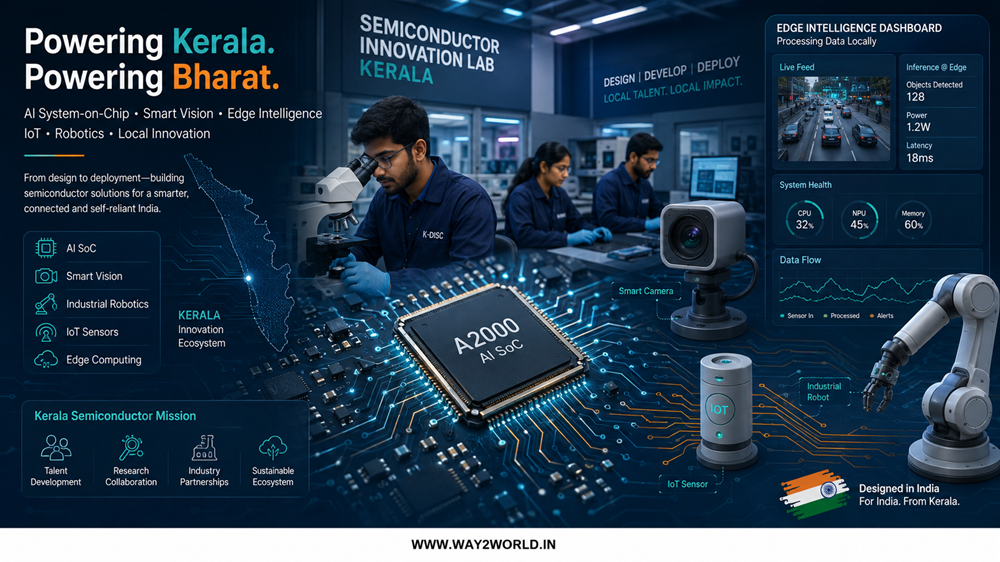
This Image has been generated by AI and has no connection to the StartUp….
I remember one stalwart from abroad had announced that Bharth can only be one of the users of AI extensively but cannot even dream of creating one. And this story proved it wrong as we have smoothly escalated from being an AI user to being an AI creator. These young team from Kerala excelled our exoectations in two fields both in building AI and in manufacturing semiconductor chips. The beauty is AI System on Chips [AI-SoC]. A2000 by Netrasemi is a Kerala-based fabless semiconductor StartUp. That has built AI-SoC. Way2World hopes for their success, because the final result would put Bharath ahead of times, globally.
Can a StartUp from Kerala help India move from using AI chips to designing them? Netrasemi’s A2000 offers an important signal. The 12-nanometre chip is built for real-time, on-device AI in compact systems, including smart cameras and industrial equipment. Its story explains why India’s semiconductor opportunity is about much more than factories.
Netrasemi designs chips but does not operate its own fabrication plant. Its A2000 is a purpose-built edge AI system-on-chip, or SoC, fabricated using TSMC’s 12-nanometre process. The company says the chip has completed silicon bring-up testing and is designed for smart cameras, surveillance systems, robotics, video gateways and industrial automation.
The basic idea is simple. Instead of sending every camera frame or sensor reading to a distant cloud server, an edge device can process important information locally. That can reduce dependence on constant connectivity, improve response time and support privacy-sensitive applications. The A2000 integrates neural processing, computer vision, image processing and security functions into one compact platform.
This matters because AI hardware is becoming a strategic layer beneath almost every intelligent product. Industrial machines, vehicles, drones, security systems and connected devices all require efficient computing.
Indian product companies that currently depend on imported chips may eventually gain more design options through local silicon and co-development partnerships.
Netrasemi’s execution challenge is substantial. Chip design must survive testing, fabrication, software integration, certification and long customer cycles. A successful demonstration is not the same as mass adoption.
The company is running customer trials and discussions with OEMs, while reported commercial production targets differ by source: India Today cited the end of 2026, while The Economic Times reported a mid-2027 commercial launch and 2027 volume production.
The broader lesson is powerful: India’s regional StartUp ecosystem is entering foundational technology. Netrasemi is not yet a proven mass-market winner, but it is a credible signal that deep-tech capability can emerge from Kerala.
Why edge AI matters:
Edge AI means processing data close to where it is created. A camera with edge AI can identify objects locally. An industrial sensor can detect an abnormal pattern without waiting for a cloud response. A robot can react faster when its critical decisions do not depend on a distant data centre.
Potential applications:
-
Smart surveillance and intelligent video analytics.
-
Industrial automation and predictive maintenance.
-
Robotics and autonomous machines.
-
Drones and unmanned systems.
-
Connected IoT sensors.
-
Automotive systems.
-
Privacy-sensitive environments.
These are potential applications, not guaranteed customer outcomes. The real test is whether Netrasemi’s chip delivers the right combination of performance, power consumption, reliability, software support and price.
A chip can be technically impressive and commercially difficult. Buyers do not purchase silicon merely because it is clever. They need development tools, stable supply, long-term support and a clear reason to redesign their products.
Understanding the A2000:
A system-on-chip combines several computing functions into one integrated component. In the A2000, Netrasemi describes a combination of in-house processing units for neural workloads, vision, image handling and security. This integration is intended for compact devices that need real-time AI without excessive power consumption.
The phrase “12 nanometre” refers to the semiconductor manufacturing process, not necessarily the physical size of every feature a consumer can see. Smaller process nodes can support greater efficiency and transistor density, but the process choice is only one part of chip performance.
The surrounding software ecosystem matters just as much. Developers need tools to convert AI models, optimise them for the chip and deploy updates safely. OEMs need documentation and technical support. Without that ecosystem, even a strong chip may remain an engineering sample rather than a widely adopted product.
The Kerala connection:
Netrasemi’s regional significance is as important as its technical announcement. Semiconductor conversations often focus on Bengaluru, Hyderabad, Chennai or large industrial corridors. Netrasemi places Thiruvananthapuram and Kerala within a more ambitious narrative: regional ecosystems can participate in strategic hardware industries.
The company’s reported work with the College of Engineering–Trivandrum under the MeitY Chip-to-Startup programme also illustrates how academic collaboration can support chip development. Its R1000 AI/ML microcontroller targets IoT sensors, while the A4000 is described as an advanced edge AI server chip under development.
This is the grassroots story worth telling. Not every regional StartUp needs to build a consumer app. Some can work on the invisible infrastructure behind future products.
From “AI user” to “AI builder”
India has become a large adopter of software and cloud-based AI tools. The next challenge is to increase participation in the underlying technology stack.
Netrasemi’s journey raises important questions:
-
Can Indian StartUps design globally competitive chips?
-
Can local OEMs adopt them at scale?
-
Can regional universities produce enough semiconductor talent?
-
Can fabless companies manage long development cycles?
-
Can India build reliable supply chains around imported fabrication?
-
Can edge AI create better privacy and energy outcomes?
These questions matter to founders, investors and students. The strongest #BusinessIdeas often sit beneath visible products. A smart camera is visible; the chip that makes it intelligent is not. A robot is visible; the processor that helps it react is hidden. Deep-tech StartUps build those hidden layers.
Business model possibilities:
Netrasemi may eventually pursue several routes [Speculative Assumption]:
-
Selling chips directly to device manufacturers.
-
Licensing chip designs or intellectual property.
-
Co-developing products with OEMs.
-
Providing development boards and software tools.
-
Building reference designs for cameras, robotics or industrial systems.
-
Expanding into IoT and edge servers.
Each route has different margins, timelines and support requirements. The company will need to balance customisation with repeatable products. Too much custom work can turn a chip company into an engineering-services business; too little flexibility can limit adoption.
Risks and editorial balance:
The A2000 announcement should be covered with enthusiasm and restraint. Netrasemi’s reported funding, silicon validation and customer trials are meaningful milestones. They are not evidence of large-scale commercial success.
Important questions remain around production volume, customer conversion, unit economics, software compatibility, export controls, supply-chain continuity and competitive pressure. The company’s reported production timeline also requires careful attribution because credible reports cite different dates.
That balance is central to trustworthy StartUp journalism. A founder deserves attention for solving a difficult problem, not automatic applause for making a large claim.
Grassroots lesson for founders:
Netrasemi offers five lessons:
-
Build for a specific use case before expanding the product roadmap.
-
Understand hardware timelines before promising fast growth.
-
Treat software tools and developer support as part of the product.
-
Work with universities and regional talent networks.
-
Measure progress through validation, customer trials and repeatable production—not headlines alone.
In A Nutshell:
Netrasemi’s A2000 is a 12-nanometre edge AI SoC.
-
It is designed for local processing in smart devices.
-
The company has reported ?125 crore in total funding.
-
Its product roadmap includes IoT and edge-server chips.
-
The venture should be covered as an emerging signal, not a proven unicorn.
Netrasemi is an important signal from Kerala’s emerging deep-tech ecosystem. Its A2000 chip shows India’s ambition to participate in AI hardware, not merely consume AI applications. The opportunity spans surveillance, robotics, industrial automation and connected devices, but commercial success will depend on manufacturing, software, customer adoption and reliable supply. For #Way2WorldStories, the story is bigger than one chip: it is about regional founders attempting to build the infrastructure beneath India’s digital future.
Editorial disclaimer: The article uses public company statements and media reports. Production dates, customer outcomes and future applications should be independently reconfirmed before publication. Funding figures are reported in Indian Rupees and are not investment advice.
Way2World invites you to follow our pages on Facebook and LinkedIn. #Way2World provides insights and news regarding #Founders, #Co-Founders, #WomenEntrepreneurs, #WomenLeaders, #Mentors, #Innovation, #Incubators, #Accelerators, and #Listing. Our #Articles, #Reviews, and #Stories explore topics related to #Funding, #IndianStartUps, their #BusinessServices, as well as the impact of #Technology. Please note that this content, including images, is generated with the assistance of AI tools and is intended solely for informational purposes regarding current trends. It is not a recommendation. We advise conducting thorough analyses tailored to your specific needs and consulting with experts in the field. Content includes contributions from the Internet – RajKishan Ganta.
DISCLAIMER: The information presented in this news item is intended solely for informational purposes and should not be interpreted as professional advice, legal opinion, or endorsement by WAY2WORLD.
We cannot guarantee the accuracy, completeness, or timeliness of the information provided as most is generated using AI. Please Note content is Generated with AI which can make mistakes. WAY2WORLD and its affiliates disclaim any liability for errors, omissions, or damages resulting from reliance on this content.
Readers are strongly encouraged to verify information through multiple sources and to consult with qualified professionals before making decisions based on this material.
The views expressed in this news item reflect the opinions of the author(s) and do not necessarily represent those of WAY2WORLD or its affiliates.
WAY2WORLD does not endorse or promote any specific product, service, or organization mentioned herein unless explicitly stated. We urge readers to exercise their discretion and judgment when interpreting and applying the information.
Comments made in this space do not represent the views of WAY2WORLD. Individuals posting comments assume full responsibility for their content. In accordance with Central Government IT regulations, any obscene or offensive statements against individuals, religions, communities, or nations are punishable offenses and legal action may be pursued against violators.
Users are responsible for ensuring AI-generated content complies with copyright laws and community guidelines. AI tools should be used responsibly and ethically, with appropriate disclosures where required.
View More To Know More:
-
https://naarm.org.in/wp-content/uploads/2026/02/a-IDEA-Newsletter-Vol-4-4-Oct-Dec-2025.pdf
-
https://www.onmanorama.com/news/kerala/2026/05/26/kerala-ai-startup-departments.html
-
https://www.linkedin.com/posts/30-indian-startups-ugcPost-7479753552765046785-gap-/
-
https://www.pib.gov.in/PressReleasePage.aspx?PRID=2214872®=3&lang=2
-
https://www.linkedin.com/posts/anoopambika_miky-ugcPost-7443839835674492928-Wwws/