
25082026 Kerala, Editorials:
-
A Kerala StartUp is exploring whether ordinary earphones can become tools for measuring brain signals.
-
NeuroTech Labs says its journey began around 2015, when consumer brain-sensing earphones were still a highly unusual idea..
-
The reported venture emerged from a 2016 CUSAT college project led by Nitin Vasanth and Asif Ashraf.
-
Public descriptions associate the venture with granted patents, National Innovation Awards recognition and early wellness applications.
-
The company’s story reflects a broader shift: India’s StartUp innovation is increasingly emerging from regional ecosystems, not only major metros.
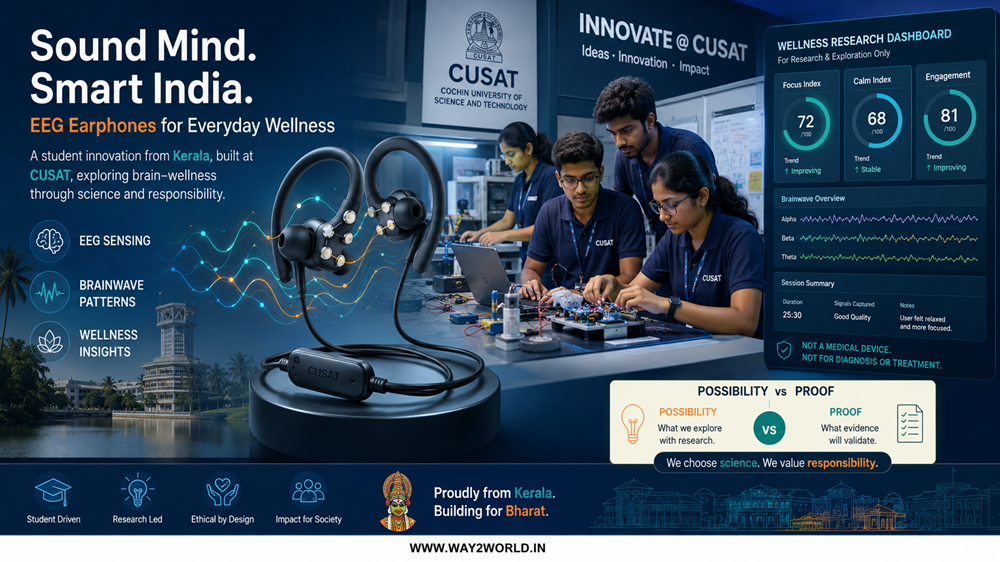
The above is a just an AI imagination and no way connected to the StartUp
Truth looks stranger than fiction at times, imagine a StartUp from a remote Kerala location trying to do what was considered impossible world-wide. Way2World hopes for their success, because the final result would put Bharath ahead of times, globally.
These two engineers have made something that reduces the complicated equipment to assess brain signals [yet to be proven on a large scale]. This is a wonder product if final results are upto the international standards. Their decade+ journey is worth a study to every founder in this ecosystem.
Can a familiar pair of earphones become a window into brain activity? NeuroTech Labs, a Kerala-based deep-tech venture, is exploring that possibility through in-ear EEG, electrodes integrated into ear-worn devices to record brain signals.
The journey offers founders a valuable lesson: frontier innovation can begin with one precise engineering problem and a very long attention span
NeuroTech Labs and India’s grassroots deep-tech story:
Electroencephalography, or EEG, records electrical activity produced by the brain. Traditional EEG systems usually depend on electrodes placed across the scalp, often in clinical or laboratory settings. In-ear EEG attempts to collect related signals through electrodes placed in or around the ear, potentially making brain monitoring more compact and suitable for natural, everyday environments.
That distinction matters. A bulky medical setup can produce valuable readings, but it is not something most people will wear during a commute, meditation session or ordinary workday. Earphones, by contrast, are already part of daily life. The strategic idea behind NeuroTech Labs is therefore not simply to build another wearable. It is to add a brain-sensing layer to a device people already understand.
According to a public LinkedIn account by Nitin Vasanth, NeuroTech Labs began working in this area around 2015, when brain-computer interfaces and smart earphones were still early technologies. The same post says the company spent years developing foundational technology and intellectual property, with support from FabLab Kerala and Kerala Startup Mission.
A separate public profile by Anoop Ambika describes the venture as emerging from a 2016 CUSAT college project led by Vasanth and Asif Ashraf. It also reports two granted foundational patents, additional applications under consideration, recognition among the Top 15 innovations at the National Innovation Awards at Rashtrapati Bhavan, and an early wellness application for assessing meditation and mindfulness.
These claims should be presented carefully. Public posts are useful reporting leads, but they are not a substitute for patent records, regulatory approvals, peer-reviewed clinical evidence or independent product testing. NeuroTech Labs should therefore be considered as an emerging deep-tech signal, not as a proven commercial or medical success.
Why in-ear EEG matters
The promise of in-ear EEG comes from making brain monitoring less intrusive. Research on ear-EEG has examined areas including sleep, drowsiness, epilepsy monitoring and cognitive-state assessment in more natural settings. Recent reviews also describe progress in flexible electrodes, miniaturised electronics and signal processing.
Possible application areas include:
-
Wellness and meditation feedback.
-
Sleep and fatigue monitoring.
-
Attention and cognitive-state research.
-
Assistive technology.
-
Neuro-rehabilitation.
-
Brain-computer interface experiments.
-
Human-computer interaction.
However, “possible” is doing important work in that list. A signal-reading device is not automatically a diagnostic medical device. Readers Please note: Wellness measurement is not the same as clinical diagnosis. A product that records brain-related data must also address accuracy, consent, privacy, cybersecurity and responsible interpretation.
The phrase “mind-reading earbuds” may produce clicks, but it can also produce confusion. The more credible explanation is that EEG captures electrical signals associated with brain activity; it does not reveal every private thought or decode a person’s mind like a science-fiction remote control.
The grassroots innovation lesson:
NeuroTech Labs is valuable to the Indian StartUp ecosystem because its story begins with a narrow hardware challenge: how can sensors be made small, reliable and comfortable enough for daily use?
That is a powerful lesson for students and wannapreneurs. Many founders begin by asking, “What billion-dollar market can I enter?” Deep-tech builders often begin with a more useful question: “What difficult technical problem has not yet been solved well?”
The difference is significant. A consumer app can sometimes reach users quickly. Hardware requires prototyping, testing, materials, manufacturing, calibration and patience. A deep-tech venture may spend years building invisible foundations before the public sees a polished product. Investors and incubators must understand that timeline without confusing patience with proof.
Kerala gives this story a second layer. India’s innovation map is becoming more distributed. According to a PIB backgrounder, India had more than 2 lakh DPIIT-recognised StartUps by December 2025, with approximately 50% originating from Tier-II and Tier-III cities. The same source says Atal Tinkering Labs had crossed 10,000 locations across 733 districts.
These figures do not prove that every regional idea will succeed. They do show that entrepreneurship is becoming less dependent on a handful of metropolitan addresses.
A CUSAT-origin venture working on brain-sensing wearables fits that broader pattern: local education, maker infrastructure and regional mentorship can become the starting point for globally relevant technology.
Business and ethical questions
For NeuroTech Labs or any similar venture, the commercial challenge is larger than proving that a sensor can collect a signal.
The company would need to answer:
-
Is the device more comfortable or affordable than existing alternatives?
-
Can the signal quality remain reliable while users move?
-
Who is the customer: consumers, wellness centres, hospitals, researchers or earphone manufacturers?
-
What evidence supports each claimed use?
-
How will brain-related data be stored, processed and deleted?
-
What happens if users misunderstand a wellness score as a medical diagnosis?
-
Can the technology be manufactured consistently at scale?
The opportunity may lie in becoming a technology layer for other products rather than selling only a direct-to-consumer earphone. Partnerships with wearable companies, research institutions, wellness providers and medical-device firms could create different routes to market. But each route brings new requirements for validation, privacy and user safety.
A strong #BusinessIdeas should therefore avoid the usual startup theatre: no instant unicorn predictions, no “revolutionary” label and no assumption that a patent guarantees market success. A patent may protect an invention; it does not guarantee customer adoption, manufacturing economics or clinical acceptance.
What founders can learn:
NeuroTech Labs offers five practical lessons for India’s next generation of builders:
-
Start with a difficult, specific problem.
-
Build foundational technology before chasing publicity.
-
Treat intellectual property as a long-term asset, not a substitute for product-market fit.
-
Use regional institutions and maker ecosystems intelligently.
-
Separate technical possibility from validated commercial use.
For students, the story also demonstrates that a college project can become the beginning of a decade-long venture. The first version does not need to look like the Perfect solution. It needs to create enough evidence for the next experiment.
In A Nutshell:
-
In-ear EEG places brain-signal sensors in or around the ear.
-
NeuroTech Labs’ public story traces its work to Kerala’s academic and innovation ecosystem.
-
Potential applications include wellness, sleep, research and assistive technology.
-
Clinical claims require independent validation and appropriate approvals.
-
Regional ecosystems are increasingly contributing to India’s deep-tech pipeline.
NeuroTech Labs represents a compelling but still developing chapter in India’s grassroots deep-tech story. Its in-ear EEG approach asks whether brain sensing can move from laboratories into familiar ear-worn devices. The opportunity is significant, but so are the technical, medical, privacy and commercial questions.
For founders, the lesson is clear: build patiently, validate honestly and explain boldly, but never let the headline run faster than the evidence. That is the kind of #TechnologyTrends journalism and #Leadership thinking the Indian StartUp ecosystem needs.
Way2World invites you to follow our pages on Facebook and LinkedIn. #Way2World provides insights and news regarding #Founders, #Co-Founders, #WomenEntrepreneurs, #WomenLeaders, #Mentors, #Innovation, #Incubators, #Accelerators, and #Listing. Our #Articles, #Reviews, and #Stories explore topics related to #Funding, #IndianStartUps, their #BusinessServices, as well as the impact of #Technology. Please note that this content, including images, is generated with the assistance of AI tools and is intended solely for informational purposes regarding current trends. It is not a recommendation. We advise conducting thorough analyses tailored to your specific needs and consulting with experts in the field. Content includes contributions from the Internet – RajKishan Ganta.
DISCLAIMER: The information presented in this news item is intended solely for informational purposes and should not be interpreted as professional advice, legal opinion, or endorsement by WAY2WORLD.
We cannot guarantee the accuracy, completeness, or timeliness of the information provided as most is generated using AI. Please Note content is Generated with AI which can make mistakes. WAY2WORLD and its affiliates disclaim any liability for errors, omissions, or damages resulting from reliance on this content.
Readers are strongly encouraged to verify information through multiple sources and to consult with qualified professionals before making decisions based on this material.
The views expressed in this news item reflect the opinions of the author(s) and do not necessarily represent those of WAY2WORLD or its affiliates.
WAY2WORLD does not endorse or promote any specific product, service, or organization mentioned herein unless explicitly stated. We urge readers to exercise their discretion and judgment when interpreting and applying the information.
Comments made in this space do not represent the views of WAY2WORLD. Individuals posting comments assume full responsibility for their content. In accordance with Central Government IT regulations, any obscene or offensive statements against individuals, religions, communities, or nations are punishable offenses and legal action may be pursued against violators.
Users are responsible for ensuring AI-generated content complies with copyright laws and community guidelines. AI tools should be used responsibly and ethically, with appropriate disclosures where required.
View More To Know More:
-
https://naarm.org.in/wp-content/uploads/2026/02/a-IDEA-Newsletter-Vol-4-4-Oct-Dec-2025.pdf
-
https://www.onmanorama.com/news/kerala/2026/05/26/kerala-ai-startup-departments.html
-
https://www.linkedin.com/posts/30-indian-startups-ugcPost-7479753552765046785-gap-/
-
https://www.pib.gov.in/PressReleasePage.aspx?PRID=2214872®=3&lang=2
-
https://www.linkedin.com/posts/anoopambika_miky-ugcPost-7443839835674492928-Wwws/