
28092026 Tamil N?du, Editorials:
-
Detect Technologies was founded in 2016 and is incubated at IIT Madras Research Park in Chennai.
-
The company has raised approximately $43.3 million (?366 crore) across three funding rounds, including a $28 million Series B in July 2022.
-
Detect Technologies employs approximately 390 personnel and operates across three continents with deployments at 100+ global sites.
-
The StartUp serves major oil and gas operators including Shell, ExxonMobil and Adani Group with its 360° Workplace Intelligence Platform.
-
The company holds over 25 patents in machine learning, robotics and sensors for industrial AI applications.
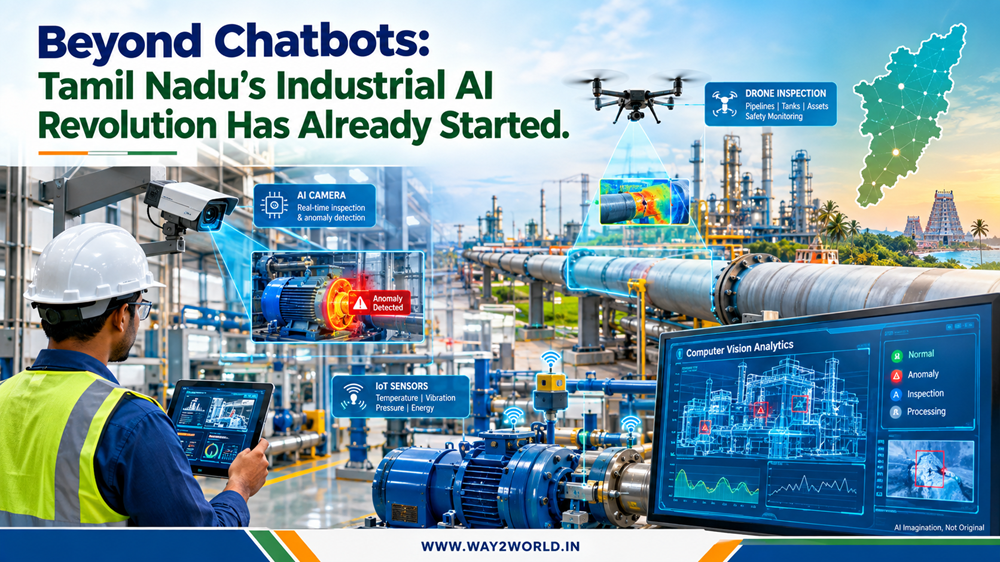
What happens when AI stops sitting inside a laptop and starts working inside a factory? Detect Technologies, incubated at IIT Madras, has raised approximately $43.3 million (?366 crore) to deploy industrial AI, computer vision, drones and IoT sensors in heavy industries. This article offers a practical framework for founders to move AI from chatbots to the factory floor.
Detect Technologies was founded in 2016 and is incubated at IIT Madras Research Park in Chennai. The company has raised approximately $43.3 million (?366 crore) across three funding rounds, including a $28 million Series B in July 2022. Detect Technologies employs approximately 390 personnel and operates across three continents with deployments at 100+ global sites.
The opportunity is not another chatbot. It is AI + sensors + cameras + drones + factories. Detect Technologies builds a 360° Workplace Intelligence Platform that integrates IoT sensors, drones, robotics and machine vision with industrial AI for automated inspections, predictive analytics and safety enhancements.
The StartUp serves major oil and gas operators including Shell, ExxonMobil and Adani Group. The company holds over 25 patents in machine learning, robotics and sensors for industrial AI applications.
The lesson for founders is clear: AI is entering the factory floor. Tamil Nadu can create an industrial AI supply chain involving engineering colleges, component manufacturers, electronics companies and Tier-2/Tier-3 entrepreneurs. That is how AI moves from demos into daily industrial life.
A founder’s framework: from idea to scale
1. Grassroots problem
Start with a real problem in a local industry. For example:
-
A factory loses production time because machines break down unexpectedly.
-
Workers enter hazardous environments for manual inspections.
-
Leaks and anomalies go undetected until they become crises.
-
Aging infrastructure requires constant monitoring and maintenance.
-
Safety compliance is difficult to ensure across large facilities.
The problem should be specific, frequent and costly.
2. Emerging technology
Identify a technology that can solve the problem. For example:
-
Computer vision for automated visual inspections.
-
Drones for accessing hazardous or difficult-to-reach areas.
-
IoT sensors for real-time monitoring of equipment health.
-
AI-powered predictive maintenance to forecast failures.
-
Digital twins for simulating and optimising operations.
The technology should be feasible, affordable and scalable.
3. Tamil Nadu example
Connect the problem and technology to Tamil Nadu’s existing ecosystem. For example:
-
Detect Technologies’ industrial AI platform and deployments.
-
IIT Madras incubation and founder background.
-
Chennai’s manufacturing and oil and gas clusters.
-
Engineering colleges producing AI and robotics talent.
The ecosystem should provide access to talent, partners and customers.
4. Indian StartUp example
Look at similar Indian StartUps for inspiration. For example:
-
Detect Technologies combines drones, robotics, IoT sensors and machine vision with ML.
-
Other industrial AI StartUps work on predictive maintenance and asset monitoring.
-
Deep-tech companies focus on computer vision and perception systems.
The examples should show that the idea is possible, not that it is guaranteed to succeed.
5. What a student/founder could build
Define a specific product or service. For example:
-
A computer vision system for detecting defects in manufacturing.
-
A drone-based inspection service for oil and gas pipelines.
-
An IoT platform for monitoring equipment health in real time.
-
An AI-powered predictive maintenance solution for factories.
-
A digital twin platform for simulating industrial operations.
The product should be simple, useful and testable.
6. Business model
Decide how the StartUp will make money. For example:
-
Sell hardware and software to industrial clients.
-
Charge for inspection and monitoring services.
-
License AI platforms for predictive maintenance.
-
Offer subscription services for continuous monitoring.
The model should be clear, sustainable and scalable.
7. Who will pay?
Identify the customer who will pay for the product. For example:
-
Oil and gas companies that need pipeline monitoring.
-
Manufacturing firms that want to reduce downtime.
-
Power plants that require asset integrity management.
-
Infrastructure operators that manage large facilities.
The customer should have a budget, a need and a decision-making process.
8. What could stop it from working?
Identify the risks and challenges. For example:
-
The technology may not work reliably in all industrial conditions.
-
The product may be too expensive for the target customer.
-
The market may be slow to adopt new technologies.
-
The regulatory environment may be complex or uncertain.
The risks should be acknowledged, not ignored.
Why this framework matters
This framework helps founders move from idea to scale in a structured way. It connects grassroots problems with emerging technologies, local ecosystems and real customers.
Tamil Nadu is particularly interesting because it has a strong manufacturing and industrial base. Detect Technologies’ 360° Workplace Intelligence Platform shows that industrial AI is feasible. The company has raised approximately $43.3 million (?366 crore) and deployed its technology at 100+ global sites.
For founders, the lesson is to focus on real problems in local industries. Can your product work across different industrial environments? Can you achieve repeat usage and sustainable unit economics?
The next wave of Indian industrial AI StartUps may come from regional ecosystems that solve real problems with AI, sensors and drones. That is the real story behind Tamil Nadu’s industrial ambition.
Market context
India’s industrial AI ecosystem includes companies such as Detect Technologies and other deep-tech StartUps working on predictive maintenance, asset monitoring and computer vision. These companies are serving oil and gas, petrochemicals, power and manufacturing sectors.
The opportunity for industrial AI StartUps is significant. Factories need predictive maintenance, safety compliance and operational excellence. However, the market is competitive. StartUps must differentiate themselves through accuracy, affordability, usability and trust. The best products will be those that solve real problems for real customers.
Risks and open questions
Industrial AI StartUps remain early-stage ventures. Their claims should be verified through independent testing and customer feedback.
Important questions include:
-
Can the technology work reliably across different industrial conditions?
-
Are the devices and apps affordable for the target customer?
-
Can the companies achieve repeat usage and customer retention?
-
What is the unit economics of industrial AI and monitoring?
-
How will the companies handle competition from traditional methods?
-
Can the model scale without losing quality or increasing costs?
These questions are not criticisms. They are the normal challenges any StartUp must address. The best article should present them as part of the story, not as obstacles that invalidate the idea.
In A Nutshell
-
Detect Technologies was founded in 2016 and incubated at IIT Madras.
-
The company raised approximately $43.3 million (?366 crore) across three funding rounds.
-
Detect Technologies employs approximately 390 personnel across three continents.
-
The StartUp serves Shell, ExxonMobil and Adani Group with its platform.
-
AI is moving from chatbots to the factory floor.
Tamil Nadu is building the foundations for an industrial AI economy. Detect Technologies’ 360° Workplace Intelligence Platform shows that the technology is feasible. The company has raised approximately $43.3 million (?366 crore) and deployed its technology at 100+ global sites. For #Way2WorldStories, the larger lesson is clear: AI is entering the factory floor. #TechnologyTrends and #DigitalTransformation become meaningful only when they improve the lives of real users.
Editorial disclaimer: This article is based on public company announcements, media reports and industry data. StartUp capabilities, deployment figures and success claims should be independently verified through customer feedback and operational data. StartUps are presented as emerging early-stage signals, not proven market leaders.
Way2World invites you to follow our pages on Facebook and LinkedIn. #Way2World provides insights and news regarding #Founders, #Co-Founders, #WomenEntrepreneurs, #WomenLeaders, #Mentors, #Innovation, #Incubators, #Accelerators, and #Listing. Our #Articles, #Reviews, and #Stories explore topics related to #Funding, #IndianStartUps, their #BusinessServices, as well as the impact of #Technology. Please note that this content, including images, is generated with the assistance of AI tools and is intended solely for informational purposes regarding current trends. It is not a recommendation. We advise conducting thorough analyses tailored to your specific needs and consulting with experts in the field. Content includes contributions from the Internet – RajKishan Ganta.
DISCLAIMER: The information presented in this news item is intended solely for informational purposes and should not be interpreted as professional advice, legal opinion, or endorsement by WAY2WORLD.
We cannot guarantee the accuracy, completeness, or timeliness of the information provided as most is generated using AI. Please Note content is Generated with AI which can make mistakes. WAY2WORLD and its affiliates disclaim any liability for errors, omissions, or damages resulting from reliance on this content.
Readers are strongly encouraged to verify information through multiple sources and to consult with qualified professionals before making decisions based on this material.
The views expressed in this news item reflect the opinions of the author(s) and do not necessarily represent those of WAY2WORLD or its affiliates.
WAY2WORLD does not endorse or promote any specific product, service, or organization mentioned herein unless explicitly stated. We urge readers to exercise their discretion and judgment when interpreting and applying the information.
Comments made in this space do not represent the views of WAY2WORLD. Individuals posting comments assume full responsibility for their content. In accordance with Central Government IT regulations, any obscene or offensive statements against individuals, religions, communities, or nations are punishable offenses and legal action may be pursued against violators.
Users are responsible for ensuring AI-generated content complies with copyright laws and community guidelines. AI tools should be used responsibly and ethically, with appropriate disclosures where required.
View More To Know More:
Comment here