
22072026 Bharath, Editorials:
- Climate-tech is no longer just about saving the planet; it is becoming a serious business category with durable demand and repeat customers.
- EV charging, battery recycling, rooftop solar and waste-to-value models are turning environmental problems into revenue opportunities.
- Circular economy StartUps are winning because they solve two problems at once: they reduce waste and improve operational efficiency.
- Policy support, corporate net-zero goals and consumer preference for sustainable products are creating a strong tailwind for founders.
- The smartest climate-tech StartUps are not selling guilt; they are selling convenience, savings, compliance and better supply chains.
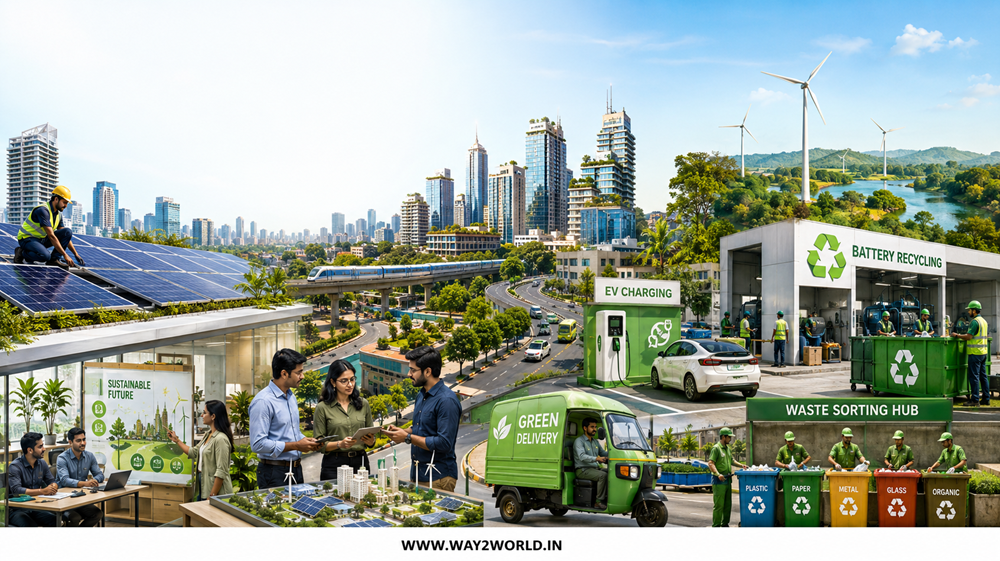
India’s climate-tech and circular-economy StartUps are moving from “nice to have” to “must have” because businesses, consumers and policymakers are all pushing in the same direction.
The opportunity now sits in clean energy, EV infrastructure, battery recycling, agri-waste and circular packaging, basically, the places where environmental pressure meets real commercial demand.
What if India’s next big StartUp wave comes not from social media, fintech, or SaaS, but from clean energy, EV infrastructure and waste-to-value businesses? That is exactly where climate-tech is heading.
As the market matures, founders are discovering that sustainability can be a business model, not just a branding statement.
India’s climate-tech story is shifting from inspiration to infrastructure. In the early days, many sustainability StartUps were treated like mission-driven experiments: important, but niche. That mindset is fading fast.
Today, businesses are under pressure from regulators, investors and enterprise buyers to adopt cleaner operations, lower emissions and more responsible sourcing. That pressure is creating room for StartUps that can deliver practical solutions at scale.
The most exciting part is that climate-tech in India is not one category. It is a cluster of business models that all point toward the same future. Clean energy StartUps are helping homes and businesses reduce dependence on traditional power sources.
EV infrastructure StartUps are making electric mobility easier to adopt by solving the unglamorous but essential problem of charging access. Battery-recycling companies are building new value chains out of old batteries, proving that waste can be treated as inventory instead of liability.
Agri-waste and circular packaging players are rethinking how materials move through the economy, often turning discarded inputs into fresh revenue streams.
That is why climate-tech is so attractive to founders and investors. The category sits at the intersection of necessity and scalability.
When a business helps another business save energy, reduce waste, or meet sustainability commitments, it is no longer a “green extra.” It becomes part of core operations. And once that happens, budgets show up more reliably than applause does.
The circular-economy angle is especially powerful in India because it fits local conditions. This is a market where resource efficiency matters, supply chains can be fragmented and cost sensitivity is real.
StartUps that can collect, process, reuse, or redistribute materials efficiently often create value in places where older systems simply leak money. In plain language: if the waste stream is messy enough, there is usually a business hiding inside it.
Battery recycling is a strong example of this shift. As EV adoption grows, end-of-life batteries become both a challenge and an opportunity.
StartUps in this space are building capabilities around collection, sorting, recovery, and material reprocessing. The value is not only environmental; it is strategic. Cleaner supply chains reduce import dependence, support energy security and make the broader EV ecosystem more resilient. That is a lot of work for something most people still think of as “just recycling.”
EV charging is another area where climate-tech becomes everyday infrastructure. Drivers do not care about the elegance of a sustainability deck if they cannot charge conveniently.
StartUps that solve location, reliability, interoperability and payment friction are the ones most likely to win. This is not glamorous founder theatre. It is plumbing. And plumbing, as every operator eventually learns, is what keeps the lights on.
Rooftop solar continues to be a major on-ramp for climate-tech because it offers a familiar value proposition: lower bills, better control and a clear sustainability story.
StartUps that simplify installation, financing, monitoring and maintenance can make solar feel less like a project and more like a service. That shift is important because the easier the adoption, the faster the market expands.
Investors are paying attention because climate-tech offers something rare: a combination of policy support, enterprise demand, and long-term relevance. Unlike trend-chasing categories that rise and fall with consumer hype, climate-tech is anchored in structural need.
Companies will keep needing power, transportation, materials, packaging and compliance. The question is not whether the category matters. The question is which StartUps can build the most efficient version of it.
For founders, the winning playbook is becoming clearer. Build around a real industrial pain point. Show how your model saves money, time, or regulatory headache. Make the product easy to adopt. And remember that in climate-tech, trust matters because customers are not buying a poster; they are buying infrastructure. If the system fails, no one can simply “refresh the app.”
The strongest StartUps in this space also tend to think beyond hardware or software alone. They design business models that combine technology with operations, logistics, financing, or service support. That hybrid approach is often what makes the model commercially sticky.
A solar platform that also helps with financing, maintenance and performance tracking is much harder to replace than a standalone product. The same logic applies to EV charging, recycling and waste recovery.
In A Nutshell:
- Climate-tech in India is moving from mission-driven language to business-driven execution.
- EV charging, battery recycling and rooftop solar are strong commercial categories.
- Circular economy models work well in India because resource efficiency has clear value.
- Enterprise buyers are increasingly drawn to solutions that support compliance and net-zero goals.
- The best StartUps in this space combine technology with real-world operations.
India’s climate-tech and circular-economy StartUps are becoming more than a sustainability story. They are becoming a commercial story, an infrastructure story and a national competitiveness story. The next unicorns in this space will likely be the ones that make clean choices feel operationally normal, financially sensible, and easy to scale.
Way2World invites you to follow our pages on Facebook and LinkedIn. #Way2World provides insights and news regarding #Founders, #Co-Founders, #WomenEntrepreneurs, #WomenLeaders, #Mentors, #Innovation, #Incubators, #Accelerators, and #Listing. Our #Articles, #Reviews, and #Stories explore topics related to #Funding, #IndianStartUps, their #BusinessServices, as well as the impact of #Technology. Please note that this content, including images, is generated with the assistance of AI tools and is intended solely for informational purposes regarding current trends. It is not a recommendation. We advise conducting thorough analyses tailored to your specific needs and consulting with experts in the field. Content includes contributions from the Internet – RajKishan Ganta.
DISCLAIMER: The information presented in this news item is intended solely for informational purposes and should not be interpreted as professional advice, legal opinion, or endorsement by WAY2WORLD.
This draft is based on general Indian market trends and high-level climate-tech and circular-economy themes, without specific sourced statistics in this version.
We cannot guarantee the accuracy, completeness, or timeliness of the information provided as most is generated using AI. Please Note content is Generated with AI which can make mistakes. WAY2WORLD and its affiliates disclaim any liability for errors, omissions, or damages resulting from reliance on this content.
Readers are strongly encouraged to verify information through multiple sources and to consult with qualified professionals before making decisions based on this material.
The views expressed in this news item reflect the opinions of the author(s) and do not necessarily represent those of WAY2WORLD or its affiliates.
WAY2WORLD does not endorse or promote any specific product, service, or organization mentioned herein unless explicitly stated. We urge readers to exercise their discretion and judgment when interpreting and applying the information.
Comments made in this space do not represent the views of WAY2WORLD. Individuals posting comments assume full responsibility for their content. In accordance with Central Government IT regulations, any obscene or offensive statements against individuals, religions, communities, or nations are punishable offenses and legal action may be pursued against violators.
Users are responsible for ensuring AI-generated content complies with copyright laws and community guidelines. AI tools should be used responsibly and ethically, with appropriate disclosures where required.