
1?70?72026 Bharath, ?E?ditorials:
- Tier-2 founders often battle investor perception bias, where funding conversations still favour metro-based teams even when the business problem is clearly local.
- Smaller cities usually have fewer incubators, fewer experienced operators, and fewer startup service providers, which makes early execution slower and more expensive.
- A successful Tier-3 founder usually wins by solving one local problem deeply, building trust first, and scaling only after the product proves itself in the market.
- VC interest in Tier-2 and Tier-3 towns is rising because smart capital now sees better deal flow, lower valuation pressure, and access to underserved markets.
- Government support schemes and incubation programmes are helping reduce the gap, but founders still need stronger sales, capital discipline, and local distribution to compete.
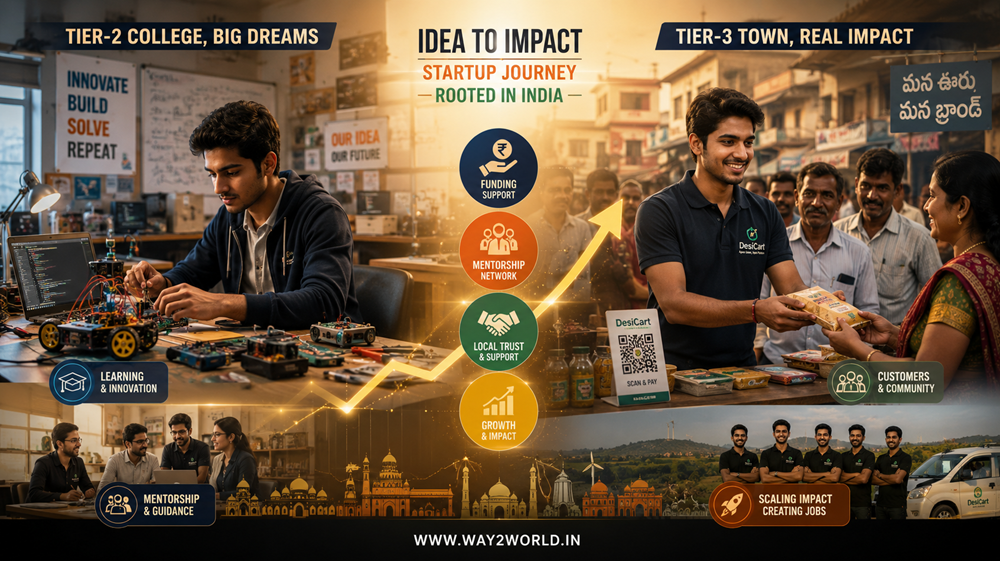
Tier-2 founders in India usually face three big hurdles: thinner investor access, weaker local mentor networks and harder customer acquisition outside familiar circles.
At the same time, VC attention is slowly widening beyond metros, especially when start?Ups show strong local traction, clear unit economics, and a path to scale?.
What makes Tier-2 and Tier-3 founders different from metro founders?
The answer is not talent; it is context. Many of them build with less capital, fewer mentors, and weaker networks, yet they are often closer to the customer and the problem. That mix creates friction, but also a serious start?Up advantage.
Tier-2 founders in India face a very practical set of challenges. The first is capital access. Even when the business is promising, many investors still default to metro cities when sourcing deals, which creates a perception gap before the pitch even begins.
The second is mentorship. In larger startup hubs, founders can quickly find lawyers, marketers, product heads, and repeat operators. In Tier-2 towns, those people exist, but they are fewer and more scattered, so learning cycles become slower. The third is distribution. Winning the first customers in a smaller market often depends on trust, not just marketing spend. That is not a bad thing, but it is definitely not the easy thing.
A good Tier-3 case study is the pattern seen in many local-market founders who start with one sharp insight, build a low-cost product, and serve users directly before thinking about expansion.
The lesson is simple: they do not begin with scale; they begin with relevance. Because they are closer to daily pain points, they can shape products around real usage, not conference-room assumptions. That often produces stronger retention and better word-of-mouth. In startup terms, that is a very expensive shortcut to avoid, but a very smart one to earn.
VC trends are changing too. More investors now see Tier-2 and Tier-3 towns as source markets rather than side markets.
Why? Deal flow is broader, competition is sometimes lower, and valuations can be more rational than in overheated metro segments. Funds and government-backed programmes are also helping with seed support, mentorship and incubation in smaller hubs.
The opportunity is real, but the winners will still be the founders who pair local insight with disciplined execution. That part never goes out of style, no matter the pin code.
In A Nutshell:
-
Tier-2 founders face lower investor visibility and thinner mentor access.
-
Local customer acquisition can be slower because trust matters more than branding.
-
Tier-3 founders often win by solving one local problem extremely well.
-
VC capital is slowly moving outward from metros into smaller markets.
-
Incubation and government support are improving the startup runway in smaller towns.
The next wave of Indian startups will not come only from Bengaluru or Delhi. Tier-2 and Tier-3 founders are proving that strong products can emerge from smaller towns when local understanding meets execution discipline. For investors, the smartest move is to look beyond geography and focus on traction, trust, and repeatable demand.
Way2World invites you to follow our pages on Facebook and LinkedIn. #Way2World provides insights and news regarding #Founders, #Co-Founders, #WomenEntrepreneurs, #WomenLeaders, #Mentors, #Innovation, #Incubators, #Accelerators, and #Listing. Our #Articles, #Reviews, and #Stories explore topics related to #Funding, #IndianStartUps, their #BusinessServices, as well as the impact of #Technology. Please note that this content, including images, is generated with the assistance of AI tools and is intended solely for informational purposes regarding current trends. It is not a recommendation. We advise conducting thorough analyses tailored to your specific needs and consulting with experts in the field. Content includes contributions from the Internet – RajKishan Ganta.
DISCLAIMER: The information presented in this news item is intended solely for informational purposes and should not be interpreted as professional advice, legal opinion, or endorsement by WAY2WORLD.
We cannot guarantee the accuracy, completeness, or timeliness of the information provided as most is generated using AI. Please Note content is Generated with AI which can make mistakes. WAY2WORLD and its affiliates disclaim any liability for errors, omissions, or damages resulting from reliance on this content.
Readers are strongly encouraged to verify information through multiple sources and to consult with qualified professionals before making decisions based on this material.
The views expressed in this news item reflect the opinions of the author(s) and do not necessarily represent those of WAY2WORLD or its affiliates.
WAY2WORLD does not endorse or promote any specific product, service, or organization mentioned herein unless explicitly stated. We urge readers to exercise their discretion and judgment when interpreting and applying the information.
Comments made in this space do not represent the views of WAY2WORLD. Individuals posting comments assume full responsibility for their content. In accordance with Central Government IT regulations, any obscene or offensive statements against individuals, religions, communities, or nations are punishable offenses and legal action may be pursued against violators.
Users are responsible for ensuring AI-generated content complies with copyright laws and community guidelines. AI tools should be used responsibly and ethically, with appropriate disclosures where required.
View More To Know More:
- https://www.youtube.com/watch?v=pXWNdp9lasQ
- https://backrr.com/blog/vc-funds-investing-in-tier2-3-india
- https://unisquareconcepts.com/work/advertising-agency-success-stories-india/startup-growth-case-study/
- https://www.linkedin.com/posts/mohd-ahmad-830a73235_startups-tier2india-venturecapital-activity-7419961139394093056-RT6S
- https://www.icsi.edu/media/webmodules/CSJ/January-2025/19.pdf
- https://wework.co.in/blogs/tier-2-3-cities-india-startup-ecosystem/