
160?72026 Bharath, Editorials
- Nearly half of India’s recognised startups are now coming from Tier-2 and Tier-3 cities, showing that entrepreneurship is becoming a national movement, not a metro-only story.
- Students from engineering colleges, degree colleges, and polytechnic institutions are building practical startups around local pain points instead of chasing trendy problems from far away.
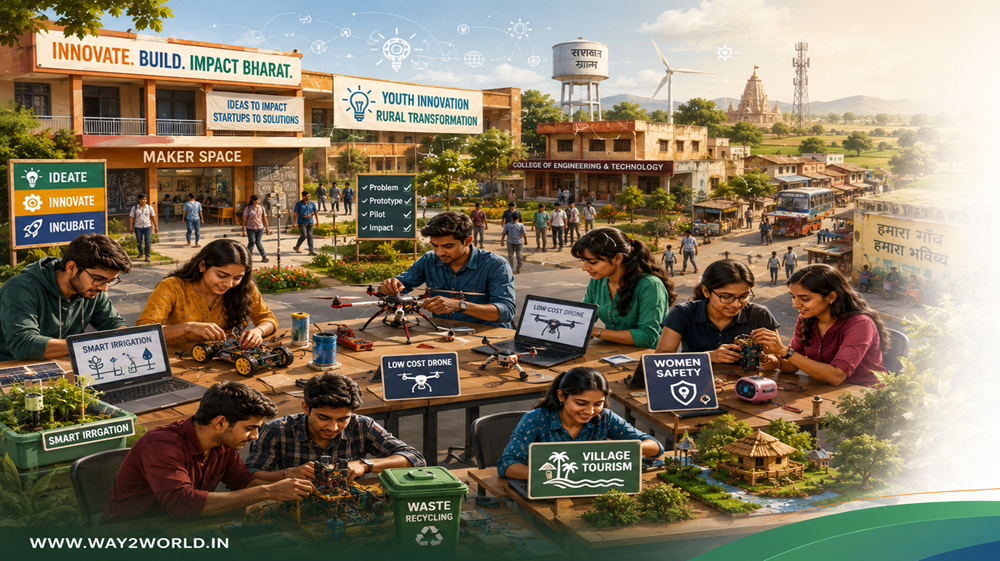
- The strongest ideas are often simple: smart irrigation, low-cost drones, local logistics, women safety, waste recycling, and village tourism.
- Campus incubation, digital payments, and rising internet access are helping students turn rough ideas into pilot products faster than before.
- Tier-2 and Tier-3 founders often understand their users better because they live closer to the problem; that is a serious advantage, not a sentimental slogan.
India’s startup map is moving beyond metros, and the signal is hard to ignore: one recent industry summary says Tier-2 and Tier-3 cities now host over 45% of recognised startups, or around 56,000 ventures.
That means the next breakout company may come from a college in Ongole, Karimnagar, or Kurnool—not just Bengaluru or Delhi.
What happens when the next generation of founders does not come from elite metro circles but from a district college with a lab, a laptop, and a local problem to solve? India is already answering that question.
As recognised startups spread across Tier-2 and Tier-3 cities, student founders are proving that ambition does not need a pin code upgrade to work.
India’s startup story is quietly being rewritten in smaller cities. For years, the spotlight stayed on Bengaluru, Hyderabad and Delhi, but that map now looks incomplete. Recent ecosystem commentary says over 45% of recognised startups come from Tier-2 and Tier-3 cities, with about 56,000 ventures emerging from these regions.
That shift matters because it changes who gets to build, who gets funded, and who gets seen.
The most interesting founders are often students from engineering colleges, degree colleges, and polytechnics who are solving local problems they know first-hand.
A student in Karimnagar sees irrigation trouble differently from a founder in a metro boardroom.
A college team in Kurnool may understand village transport, waste handling, or women safety in a way outsiders simply cannot. That local advantage often creates better products, not just better stories.
This is where grassroots innovation becomes powerful. Smart irrigation tools can help farmers use water more wisely. Low-cost drones can support surveying and crop checks.
Local logistics startups can reduce delays in small-town supply chains. Waste recycling ideas can turn a nuisance into income. Village tourism platforms can bring revenue to communities that have been overlooked for years.
Even a rough prototype built in a campus lab can become a real startUp if it solves a real problem. That is the beauty of StartUp growth outside metros: less glamour, more usefulness, and usually less ego in the pitch deck.
The ecosystem is also changing around these students. Cheaper internet, digital payments, startup schemes, and campus incubators are giving small-town founders more confidence and better tools. Instead of waiting for permission, they are testing ideas early, finding local users, and building with limited budgets.
For investors, this widens the deal pipeline. For colleges, it turns classrooms into launchpads. For India, it means innovation is becoming more inclusive, more practical, and more evenly spread.
In A Nutshell:
-
Tier-2 and Tier-3 cities are now a major source of recognised startups in India.
-
Student founders are solving local problems that are easy to overlook from metros.
-
Practical ideas like irrigation, drones, logistics, safety, and recycling fit local markets well.
-
Campus ecosystems are becoming more supportive through incubation and digital access.
-
Geography is becoming less important than problem understanding and execution quality.
The next wave of Indian startups will not be defined only by famous campuses or metro addresses. It will also come from students in Tier-2 and Tier-3 colleges who understand local needs and build for real communities. If that trend continues, Ongole, Karimnagar, and Kurnool may produce founders whose ideas travel much farther than their hometowns.
Way2World invites you to follow our pages on Facebook and LinkedIn. #Way2World provides insights and news regarding #Founders, #Co-Founders, #WomenEntrepreneurs, #WomenLeaders, #Mentors, #Innovation, #Incubators, #Accelerators, and #Listing. Our #Articles, #Reviews, and #Stories explore topics related to #Funding, #IndianStartUps, their #BusinessServices, as well as the impact of #Technology. Please note that this content, including images, is generated with the assistance of AI tools and is intended solely for informational purposes regarding current trends. It is not a recommendation. We advise conducting thorough analyses tailored to your specific needs and consulting with experts in the field. Content includes contributions from the Internet – RajKishan Ganta.
DISCLAIMER: The information presented in this news item is intended solely for informational purposes and should not be interpreted as professional advice, legal opinion, or endorsement by WAY2WORLD.
We cannot guarantee the accuracy, completeness, or timeliness of the information provided as most is generated using AI. Please Note content is Generated with AI which can make mistakes. WAY2WORLD and its affiliates disclaim any liability for errors, omissions, or damages resulting from reliance on this content.
Readers are strongly encouraged to verify information through multiple sources and to consult with qualified professionals before making decisions based on this material.
The views expressed in this news item reflect the opinions of the author(s) and do not necessarily represent those of WAY2WORLD or its affiliates.
WAY2WORLD does not endorse or promote any specific product, service, or organization mentioned herein unless explicitly stated. We urge readers to exercise their discretion and judgment when interpreting and applying the information.
Comments made in this space do not represent the views of WAY2WORLD. Individuals posting comments assume full responsibility for their content. In accordance with Central Government IT regulations, any obscene or offensive statements against individuals, religions, communities, or nations are punishable offenses and legal action may be pursued against violators.
View More To Know More:
- https://wework.co.in/blogs/tier-2-3-cities-india-startup-ecosystem/
- https://wadhwanifoundation.org/building-startups-beyond-metros-entrepreneurship-in-tier-2-and-tier-3-cities/
- https://www.marwaricatalysts.com/blogs/india-s-tier-2-tier-3-cities-the-next-startup-hotspots
- https://www.marwaricatalysts.com/blogs/how-startups-from-tier-2-cities
- https://yourstory.com/2024/01/innovation-entrepreneurship-indias-tier-2-tier-3-cities