
29092026 Tamilnadu, Editorials:
-
Solinas Integrity raised $5.5 million (?52.66 crore) in Series A1 funding in August 2026 to scale robotics and AI for water and sanitation infrastructure.
-
The Chennai-based StartUp develops Endobot for robotic pipeline inspection and HomoSEP for mechanised sewer and septic-tank cleaning
-
Solinas says its technology has been deployed across 35+ cities and 15+ states in India, with operations expanding in the Middle East.
-
The company’s SWASTH AI platform converts inspection data into digital maps, infrastructure records and maintenance insights.
-
Solinas was founded in 2018 by IIT Madras alumni Divanshu Kumar and Moinak Banerjee and is incubated at IIT Madras.
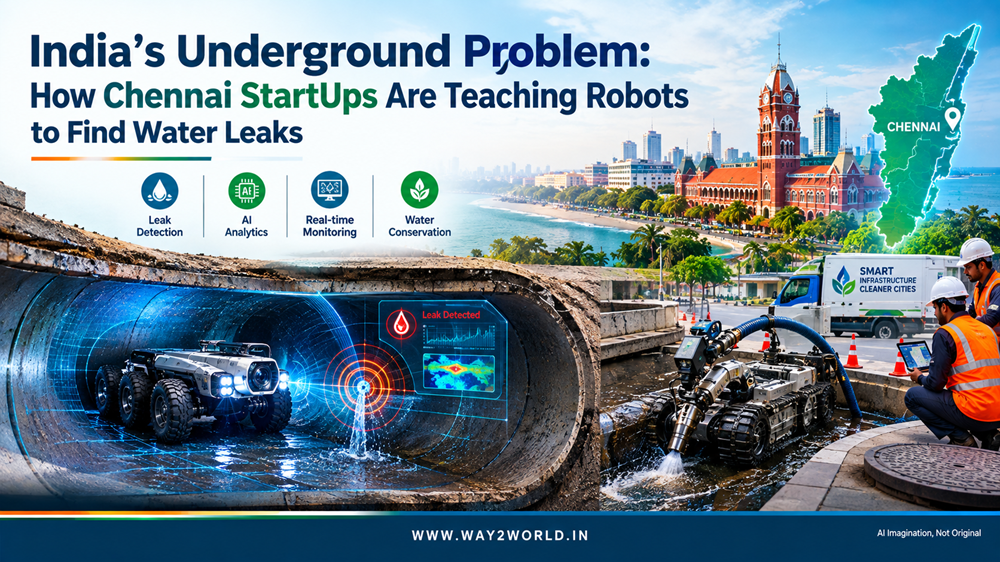
Can robots fix India’s underground water problem? Solinas Integrity raised $5.5 million (Rs. 52.66 crore) in August 2026 to scale robotics and AI for inspecting underground water and sewage infrastructure. This article offers a practical framework for founders to turn boring problems into valuable StartUp opportunities
Solinas Integrity raised $5.5 million (Rs. 52.66 crore) in Series A1 funding in August 2026 to scale robotics and AI for water and sanitation infrastructure. The Chennai-based StartUp develops Endobot for robotic pipeline inspection and HomoSEP for mechanised sewer and septic-tank cleaning. Solinas says its technology has been deployed across 35+ cities and 15+ states in India, with operations expanding in the Middle East.
The opportunity is not another consumer app. It is solving a boring problem with difficult technology. Underground infrastructure is difficult to inspect. Traditional methods require digging up roads or sending humans into hazardous sewers. Solinas uses robots to crawl inside pipelines, detect leaks, blockages and contamination in real time.
The company’s SWASTH AI platform converts inspection data into digital maps, infrastructure records and maintenance insights. This enables smarter, predictive infrastructure management and reduces non-revenue water losses.
The lesson for founders is clear: boring problem + difficult technology = potentially valuable StartUp opportunity. Solinas was founded in 2018 by IIT Madras alumni and is incubated at IIT Madras. That is how deep-tech moves from labs into cities.
A founder’s framework: from idea to scale
Grassroots problem
Start with a real problem that is easy to understand. For example:
-
Cities lose water through underground pipeline leaks.
-
Sewers overflow because blockages are not detected early.
-
Workers enter hazardous manholes and septic tanks.
-
Road excavation for inspection causes traffic and cost.
-
Water contamination goes undetected until it becomes a crisis.
The problem should be specific, frequent and costly.
Emerging technology
Identify a technology that can solve the problem. For example:
-
Robotic crawlers for pipeline inspection.
-
AI-powered defect detection from video and sensor data.
-
Mechanised cleaning systems for sewers and septic tanks.
-
Digital twin platforms for underground infrastructure.
-
Predictive analytics for maintenance planning.
The technology should be feasible, affordable and scalable.
Chennai example
Connect the problem and technology to Chennai’s existing ecosystem. For example:
-
Solinas Integrity’s Endobot and HomoSEP deployments.
-
IIT Madras incubation and founder background.
-
Chennai’s water and sanitation challenges as a testing ground.
-
Municipal corporations and utilities as potential customers.
The ecosystem should provide access to talent, partners and customers.
Indian StartUp example
Look at similar Indian StartUps for inspiration. For example:
-
Solinas uses robots to inspect pipelines and clean sewers.
-
Genrobotics builds bandicoot robots for manhole cleaning.
-
Other deep-tech StartUps work on infrastructure monitoring and AI analytics.
The examples should show that the idea is possible, not that it is guaranteed to succeed.
What a student/founder could build
Define a specific product or service. For example:
-
A robotic inspection service for municipal water pipelines.
-
An AI platform for detecting leaks from sensor data.
-
A mechanised cleaning system for septic tanks.
-
A digital twin platform for underground infrastructure.
-
A predictive maintenance service for utilities.
The product should be simple, useful and testable.
Business model
Decide how the StartUp will make money. For example:
-
Charge municipalities for inspection and cleaning services.
-
Sell robots and software to utilities and industrial clients.
-
License AI platforms for infrastructure management.
-
Offer subscription services for predictive maintenance.
The model should be clear, sustainable and scalable.
Who will pay?
Identify the customer who will pay for the product. For example:
-
Municipal corporations that manage water and sewage.
-
Water utilities that want to reduce losses.
-
Industrial facilities with underground pipelines.
-
Real estate developers managing large complexes.
The customer should have a budget, a need and a decision-making process.
What could stop it from working?
Identify the risks and challenges. For example:
-
The technology may not work reliably in all pipeline conditions.
-
The product may be too expensive for municipal budgets.
-
The market may be slow to adopt new technologies.
-
The regulatory environment may be complex or uncertain.
The risks should be acknowledged, not ignored.
Why this framework matters
This framework helps founders move from idea to scale in a structured way. It connects grassroots problems with emerging technologies, local ecosystems and real customers.
Chennai is particularly interesting because it has water and sanitation challenges that create demand for innovative solutions. Solinas Integrity’s Endobot and HomoSEP deployments show that the technology is feasible. The company raised $5.5 million (?52.66 crore) in Series A1 funding to scale its operations.
For founders, the lesson is to focus on real problems that are easy to understand. Can your product work across different pipeline diameters and conditions? Can you achieve repeat usage and sustainable unit economics?
The next wave of Indian deep-tech StartUps may come from regional ecosystems that solve real problems with robotics and AI. That is the real story behind Chennai’s underground ambition.
Market context
India’s deep-tech ecosystem includes companies such as Solinas Integrity, Genrobotics and other infrastructure monitoring StartUps. These companies are working on robotics, AI and infrastructure management.
The opportunity for deep-tech StartUps is significant. Cities need water conservation, sewer safety and smart infrastructure. However, the market is competitive. StartUps must differentiate themselves through accuracy, affordability, usability and trust. The best products will be those that solve real problems for real customers.
Risks and open questions
Deep-tech StartUps remain early-stage ventures. Their claims should be verified through independent testing and customer feedback.
Important questions include:
-
Can the technology work reliably across different pipeline conditions?
-
Are the robots and software affordable for municipal budgets?
-
Can the companies achieve repeat usage and customer retention?
-
What is the unit economics of robotic inspection and cleaning?
-
How will the companies handle competition from traditional methods?
-
Can the model scale without losing quality or increasing costs?
These questions are not criticisms. They are the normal challenges any StartUp must address. The best article should present them as part of the story, not as obstacles that invalidate the idea.
In A Nutshell
-
Solinas Integrity raised $5.5 million (Rs. 52.66 crore) in Series A1 funding.
-
The StartUp develops Endobot for pipeline inspection and HomoSEP for sewer cleaning.
-
Solinas says its technology is deployed across 35+ cities and 15+ states.
-
The company’s SWASTH AI platform converts inspection data into digital maps.
-
Boring problem + difficult technology = valuable StartUp opportunity.
Chennai is building the foundations for a deep-tech economy focused on underground infrastructure. Solinas Integrity’s Endobot and HomoSEP deployments show that the technology is feasible. The company raised $5.5 million (?52.66 crore) in Series A1 funding to scale its operations. For #Way2WorldStories, the larger lesson is clear: boring problem + difficult technology = potentially valuable StartUp opportunity. #TechnologyTrends and #DigitalTransformation become meaningful only when they improve the lives of real users.
Editorial disclaimer: This article is based on public company announcements, media reports and industry data. StartUp capabilities, deployment figures and success claims should be independently verified through customer feedback and operational data. StartUps are presented as emerging early-stage signals, not proven market leaders.
Way2World invites you to follow our pages on Facebook and LinkedIn. #Way2World provides insights and news regarding #Founders, #Co-Founders, #WomenEntrepreneurs, #WomenLeaders, #Mentors, #Innovation, #Incubators, #Accelerators, and #Listing. Our #Articles, #Reviews, and #Stories explore topics related to #Funding, #IndianStartUps, their #BusinessServices, as well as the impact of #Technology. Please note that this content, including images, is generated with the assistance of AI tools and is intended solely for informational purposes regarding current trends. It is not a recommendation. We advise conducting thorough analyses tailored to your specific needs and consulting with experts in the field. Content includes contributions from the Internet – RajKishan Ganta.
DISCLAIMER: The information presented in this news item is intended solely for informational purposes and should not be interpreted as professional advice, legal opinion, or endorsement by WAY2WORLD.
We cannot guarantee the accuracy, completeness, or timeliness of the information provided as most is generated using AI. Please Note content is Generated with AI which can make mistakes. WAY2WORLD and its affiliates disclaim any liability for errors, omissions, or damages resulting from reliance on this content.
Readers are strongly encouraged to verify information through multiple sources and to consult with qualified professionals before making decisions based on this material.
The views expressed in this news item reflect the opinions of the author(s) and do not necessarily represent those of WAY2WORLD or its affiliates.
WAY2WORLD does not endorse or promote any specific product, service, or organization mentioned herein unless explicitly stated. We urge readers to exercise their discretion and judgment when interpreting and applying the information.
Comments made in this space do not represent the views of WAY2WORLD. Individuals posting comments assume full responsibility for their content. In accordance with Central Government IT regulations, any obscene or offensive statements against individuals, religions, communities, or nations are punishable offenses and legal action may be pursued against violators.
Users are responsible for ensuring AI-generated content complies with copyright laws and community guidelines. AI tools should be used responsibly and ethically, with appropriate disclosures where required.
View More To Know More:
-
https://www.linkedin.com/posts/startupfunding-deeptech-climatetech-share-7491745873404514304-2ZYC/
-
https://www.linkedin.com/posts/startupfunding-deeptech-climatetech-share-7491745873404514304-2ZYC/
-
https://www.linkedin.com/posts/startupfunding-deeptech-climatetech-share-7491745873404514304-2ZYC/
-
https://www.linkedin.com/posts/startup-seriesa-funding-ugcPost-7491321467951910912-Z3lL/
Comment here