
11082026 Bharat, Editorials
-
India had 886 million active internet users in 2024, and the market is still expanding toward 900 million-plus, with rural users driving much of the next growth wave.
-
870 million users accessed the internet in Indic languages in 2024, and 57% of urban users said they prefer Indic-language content too.
-
Rural users are growing 2X faster than urban users, which means the next internet defaults will be shaped by village and small-town behavior, not just metro habits.
-
Voice, mixed-script search, local numerals and colloquial microcopy are no longer “nice to have”; they are core UX patterns for inclusion and retention.
-
Platforms such as ShareChat, Meesho, PhonePe and Koo show that winning India often means designing for language, trust and low-bandwidth reality at the same time.
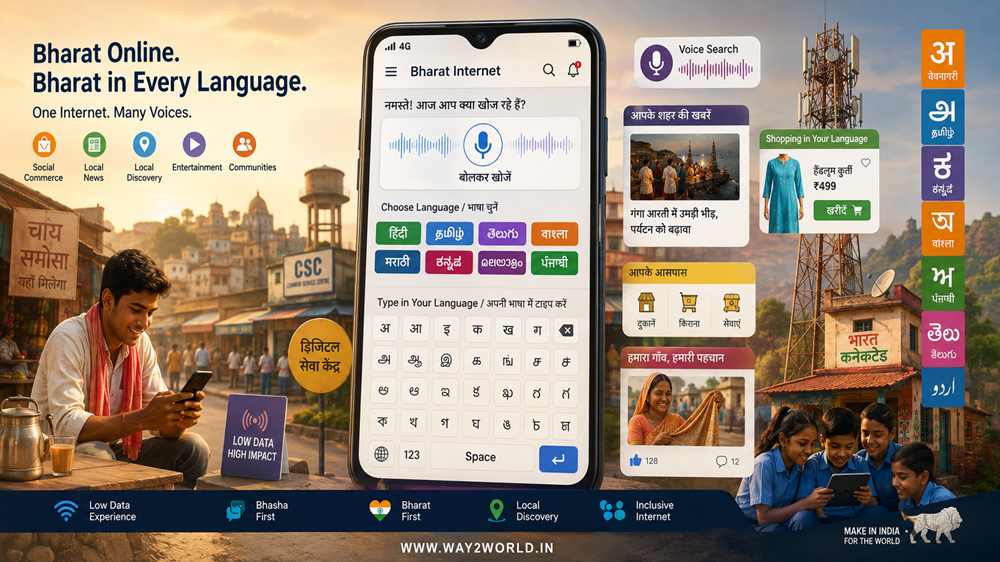
What if the biggest internet growth engine in India is not English-first metro users, but people who want the web in Tamil, Hindi, Marathi, Bengali or Telugu? With 886 million active users and 870 million Indic-language users in 2024, vernacular UX has become a business necessity, not a feature.
India’s internet is no longer a metro-only story. The ICUBE 2024 report shows 886 million active users, with rural India accounting for 488 million and growing faster than urban India. It also shows 870 million users accessed the internet in Indic languages, while 57% of urban users prefer regional-language content.
For StartUps, this is the signal: if the experience is English-heavy, the market is smaller than the opportunity.
The product categories are becoming clearer. Regional search, voice-first assistants, local-language content feeds, mixed-script keyboards and script-aware input tools are all trying to reduce friction for users who think in one language but type in another.
ShareChat and Moj built communities around native-language discovery; Meesho localized onboarding and catalog UX for Bharat users; PhonePe and Jupiter simplified mobile flows for low-bandwidth, high-trust use cases. That is vernacular UX in action: not translation, but cultural fit.
The monetization challenge is real. Advertising, commerce and moderation become harder when content is multilingual and community-driven and platforms must balance growth with trust and safety.
Yet the upside is obvious: regional-language users are often the newest, stickiest and most under served audience on the internet.
For founders and investors, the opportunity is to build interfaces that feel native, useful and light on data—because in India, language is not decoration. It is distribution.
In A Nutshell:
-
Rural internet growth is outpacing urban growth, changing how products must be designed.
-
Indic-language usage is now mainstream across both rural and urban India.
-
Voice and mixed-script search reduce friction for first-time or semi-literate users.
-
Monetization in vernacular markets requires careful content moderation and platform trust.
-
Local-language UX is now a growth strategy for commerce, not just content.
The next phase of India’s digital transformation will be won in local languages, on low-bandwidth phones, and through voice, search and simple design. Startups that treat vernacular UX as core product strategy—not a localization add-on—can unlock scale, trust and commerce across the country.
Way2World invites you to follow our pages on Facebook and LinkedIn. #Way2World provides insights and news regarding #Founders, #Co-Founders, #WomenEntrepreneurs, #WomenLeaders, #Mentors, #Innovation, #Incubators, #Accelerators, and #Listing. Our #Articles, #Reviews, and #Stories explore topics related to #Funding, #IndianStartUps, their #BusinessServices, as well as the impact of #Technology. Please note that this content, including images, is generated with the assistance of AI tools and is intended solely for informational purposes regarding current trends. It is not a recommendation. We advise conducting thorough analyses tailored to your specific needs and consulting with experts in the field. Content includes contributions from the Internet – RajKishan Ganta.
DISCLAIMER: The information presented in this news item is intended solely for informational purposes and should not be interpreted as professional advice, legal opinion, or endorsement by WAY2WORLD.
We cannot guarantee the accuracy, completeness, or timeliness of the information provided as most is generated using AI. Please Note content is Generated with AI which can make mistakes. WAY2WORLD and its affiliates disclaim any liability for errors, omissions, or damages resulting from reliance on this content.
Readers are strongly encouraged to verify information through multiple sources and to consult with qualified professionals before making decisions based on this material.
The views expressed in this news item reflect the opinions of the author(s) and do not necessarily represent those of WAY2WORLD or its affiliates.
WAY2WORLD does not endorse or promote any specific product, service, or organization mentioned herein unless explicitly stated. We urge readers to exercise their discretion and judgment when interpreting and applying the information.
Comments made in this space do not represent the views of WAY2WORLD. Individuals posting comments assume full responsibility for their content. In accordance with Central Government IT regulations, any obscene or offensive statements against individuals, religions, communities, or nations are punishable offenses and legal action may be pursued against violators.
Users are responsible for ensuring AI-generated content complies with copyright laws and community guidelines. AI tools should be used responsibly and ethically, with appropriate disclosures where required.
View More To Know More:
1. https://ijcrt.org/papers/IJCRT2510123.pdf
2. https://www.perplexity.ai/search/0027b06a-01d1-45a8-a9a0-3953a843a275
3. https://nikhilpahwa.com/on-koo-failures-and-successes-in-indias-startup-ecosystem/
4. https://procreator.design/blog/indian-startups-get-right-about-product-ux/
5. https://procreator.design/blog/indian-startups-get-right-about-product-ux/
7. https://www.iamai.in/sites/default/files/research/Kantar_%20IAMAI%20report_2024_.pdf