
10082026 Bharat, Editorials:
-
NIST says organizations should begin migrating now to post-quantum cryptography, because the first three PQC standards are ready for implementation today.
-
India’s DST-led Task Force warns that quantum risk is no longer theoretical, pointing to “harvest now, decrypt later” attacks and a faster-than-expected threat timeline.
-
India’s National Quantum Mission has a Rs. 6,003.65 crore budget for 2023–2031 and includes quantum communication, sensing, computing and materials hubs.
-
The country is building a national testing and certification framework with layered assurance levels, which could shape how banks, telecoms and critical infrastructure buy quantum-safe products.
-
StartUps such as InstaSafe, Sequretek and QNu Labs are part of an emerging quantum-safe and cybersecurity ecosystem that can serve enterprises, government and regulated sectors.
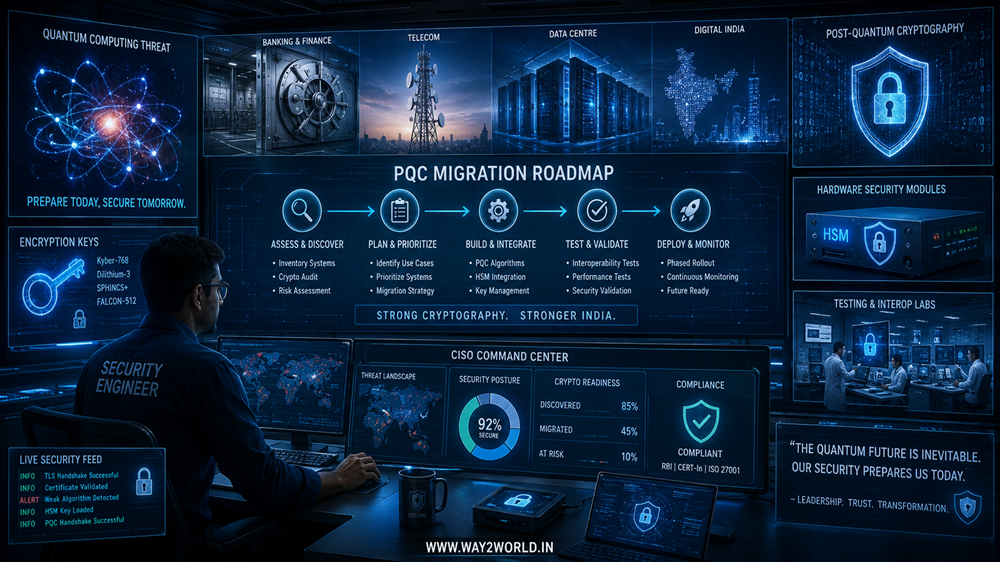
What happens when today’s encryption becomes tomorrow’s weak link? NIST says migration must begin now, while India’s quantum task force warns of “harvest now, decrypt later” risks. For enterprises, this is no longer a lab problem; it is a boardroom issue with real security and compliance stakes.
Quantum-safe cryptography is becoming a business necessity because the math protecting today’s Internet was never built for powerful quantum computers.
RSA, ECC and Diffie-Hellman remain everywhere, from banking logins to telecom authentication, but NIST’s released standards, ML-KEM, ML-DSA and SLH-DSA, are ready now and vulnerable algorithms will be deprecated by 2035.
India’s DST Task Force warns that adversaries may already be collecting encrypted data today for future decryption, the classic “harvest now, decrypt later” problem.
That risk is creating several StartUp categories. Post-quantum cryptography products replace broken algorithms; key-management and crypto-agility tools help enterprises swap protocols without breaking workflows; secure enclaves and HSM/KMS upgrades protect long-lived systems; and threat-detection products help find where weak crypto still hides.
For founders, this is a B2B SaaS and deep-tech market with very long sales cycles but high compliance value.
India’s policy response matters. The National Quantum Mission, backed by Rs. 6,003.65 crore, has formed task forces, testing frameworks and assurance levels for critical sectors such as finance, telecom and defence.
The roadmap leans on pilots, hybrid PQC-QKD systems, cryptographic inventories and vendor CBOMs. That means adoption will happen through partnerships with banks, government, telecom providers and system integrators, not flashy consumer launches.
In cybersecurity, the best product is often the one that disappears into the background while still keeping the bad guys out.
In A Nutshell:
-
NIST’s PQC standards are already available for implementation.
-
India is building formal PQC testing and certification infrastructure.
-
“Harvest now, decrypt later” makes old encrypted data a future liability.
-
Banks, telecoms and defence are the highest-priority early adopters.
-
The opportunity spans software, hardware, compliance and migration services.
Quantum-safe security is not a “later” problem. It is a now problem with a long runway. StartUps that can make migration practical, auditable and affordable will help Indian enterprises protect data, satisfy regulators and modernise defences before quantum risk turns from warning to incident.
Way2World invites you to follow our pages on Facebook and LinkedIn. #Way2World provides insights and news regarding #Founders, #Co-Founders, #WomenEntrepreneurs, #WomenLeaders, #Mentors, #Innovation, #Incubators, #Accelerators, and #Listing. Our #Articles, #Reviews, and #Stories explore topics related to #Funding, #IndianStartUps, their #BusinessServices, as well as the impact of #Technology. Please note that this content, including images, is generated with the assistance of AI tools and is intended solely for informational purposes regarding current trends. It is not a recommendation. We advise conducting thorough analyses tailored to your specific needs and consulting with experts in the field. Content includes contributions from the Internet – RajKishan Ganta.
DISCLAIMER: The information presented in this news item is intended solely for informational purposes and should not be interpreted as professional advice, legal opinion, or endorsement by WAY2WORLD.
We cannot guarantee the accuracy, completeness, or timeliness of the information provided as most is generated using AI. Please Note content is Generated with AI which can make mistakes. WAY2WORLD and its affiliates disclaim any liability for errors, omissions, or damages resulting from reliance on this content.
Readers are strongly encouraged to verify information through multiple sources and to consult with qualified professionals before making decisions based on this material.
The views expressed in this news item reflect the opinions of the author(s) and do not necessarily represent those of WAY2WORLD or its affiliates.
WAY2WORLD does not endorse or promote any specific product, service, or organization mentioned herein unless explicitly stated. We urge readers to exercise their discretion and judgment when interpreting and applying the information.
Comments made in this space do not represent the views of WAY2WORLD. Individuals posting comments assume full responsibility for their content. In accordance with Central Government IT regulations, any obscene or offensive statements against individuals, religions, communities, or nations are punishable offenses and legal action may be pursued against violators.
Users are responsible for ensuring AI-generated content complies with copyright laws and community guidelines. AI tools should be used responsibly and ethically, with appropriate disclosures where required.
View More To Know More:
1. https://postquantum.com/security-pqc/indias-quantum-safe-roadmap/
3.https://www.cert-in.org.in/s2cMainServlet?pageid=PUBVLNOTES02&VLCODE=CIAD-2025-0018 4. https://dst.gov.in/sites/default/files/Report_TaskForce_PQMigration_4Feb26%20(v1).pdf